
A service from Fondazione CR Firenze to facilitate access to European funding and strengthen local organisations’ project capacity
Europe desk: to translate opportunities into actionable projects
In 2022 Fondazione CR Firenze launched Sportello Europa, an initiative created with a very specific goal: to support local organisations, associations and institutions in accessing European and national funding.
The project was born at a time of great ferment for public investment policies marked by the launch of the PNRR and the coming on stream of the European Programming 2021-2027. A time of extraordinary availability of funds, but also of increasing complexity, in which many local authorities and Third Sector organizations were struggling to translate opportunities into feasible projects. It was in this context that the decision matured to create a presidium capable of strengthening the local organisations’ planning capacity and helping local actors navigate
The Desk was therefore configured from the outset as an operational and strategic garrison, a bridge between local organisations’ opportunities and projects, capable of accompanying beneficiaries all along the way, from idea to application to project implementation.
An integrated service model
During its first four years of operation, the Desk has structured a multi-tiered intervention model:
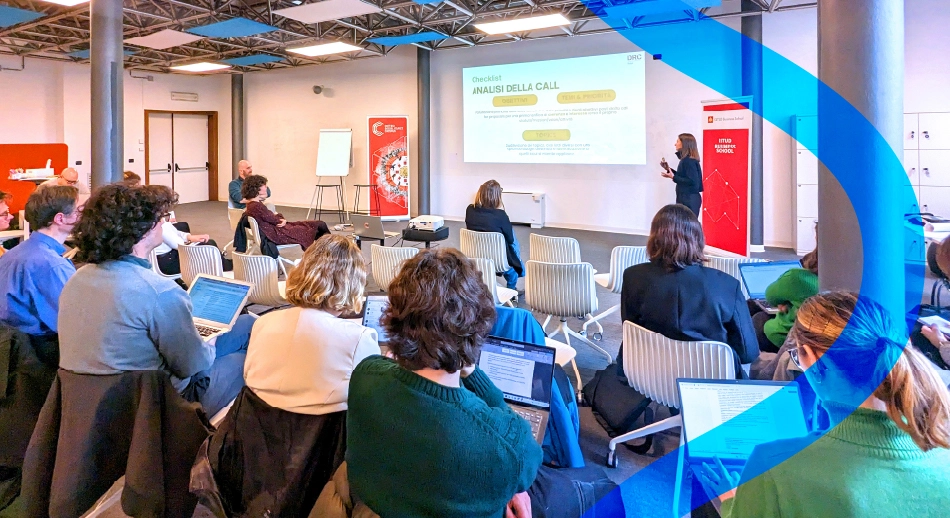
- Information, with an up-to-date calls calendar on the Foundation’s website, thematic webinars, newsletters, and informational materials that clearly explain available funding opportunities;
- Orientation, through one-on-one interviews that help entities and organizations identify calls that are most relevant and consistent with their mission and define effective project strategies;
- Technical support, both ordinary and specialized, to provide assistance in verification of requirements, drafting of documentation and co-design in the most complex cases.
How the Desk Works
The Europe Desk is an ongoing and accessible service designed to respond flexibly to the diverse needs of the Foundation’s beneficiaries.
It is active Monday through Friday via e-mail, with the possibility of scheduling appointments in-office and online to delve into more complex requests or initiate dedicated accompaniment and co-design paths.
All updates and funding opportunities are collected in a searchable online call calendar, which is constantly updated according to the areas of activity of the Foundation’s grantees. This is complemented by regular newsletters and thematic webinars, tools that make information widespread and accessible even to those new to the world of European funding.
The quality of the service is ensured by working with a team of consultants specialized in funded planning, who ensure qualified technical accompaniment.
Achievements
From 2022 to 2025, the Desk organized 20 thematic webinars (with more than 3,000 views), sent newsletters dedicated to key funding opportunities, and initiated 136 interlocutions with entities and organizations in the culture, education, and social sectors.
The technical support covered a wide range of national and European measures, including several PNRR calls (Cultural and Social Regeneration of Small Historic Villages; Enhancement of Rural Architecture; Digital and Ecological Transition of Cultural and Creative Bodies (TOCC); Removal of Architectural Barriers in Cultural Venues) as well as directly managed European programs such as Creative Europe, Erasmus+, CERV (Citizens, Equality, Rights and Values), and indirectly managed programs such as FAMI and ESF+.
As a result of this work, beneficiaries have been awarded 7.85 million in resources, against funded projects with a total value of 8.4 million, with an additional 1.26 million in the process of being appraised.
But more than the numbers, what counts is the long-term impact, that is, the attraction of generative resources to the local organisations and the growth of the planning capacity of the activated actors. Not only that, it also counts, and above all, what has been built over time: relationships, trust and collaboration. In fact, many pathways were born from an initial orientation meeting, from a question, a doubt, a still undefined idea, and were transformed, step by step, into co-design processes, up to the submission of complex applications on European and national calls.
Toward the Europe Desk 2026
With the extraordinary phase of the NRP over, the gaze is now turned to the scenarios of the European Programming 2021-2027 and the next financial framework 2028-2034, which will include initiatives such as the new AgoraEU program.
Emerging priorities, namely support for the creation of international partnerships, assistance in project management, and continuing education, will guide the development of the Desk, for which the aim is thus to strengthen a now well-established garrison.