As we will see later, the model presented constitutes the “basic version” of the logical framework.
In fact, it is possible (indeed, recommended) to add columns referring to the starting value of each indicator, the value that we aim to achieve, and the current value recorded at set times in the life of the project, for monitoring purposes.
It is also possible to alternatively define the different levels of the intervention logic, i.e., in terms of impact (= general goal), outcome (= specific goal) and output (= expected results or tangible products); and to add “intermediate goals” to the intervention logic.
However, since these changes do not change the layout of the “basic model” logical framework but only detail some aspects of it, we prefer to keep a simpler structure for illustrative and illustrative purposes.
[2] For more:
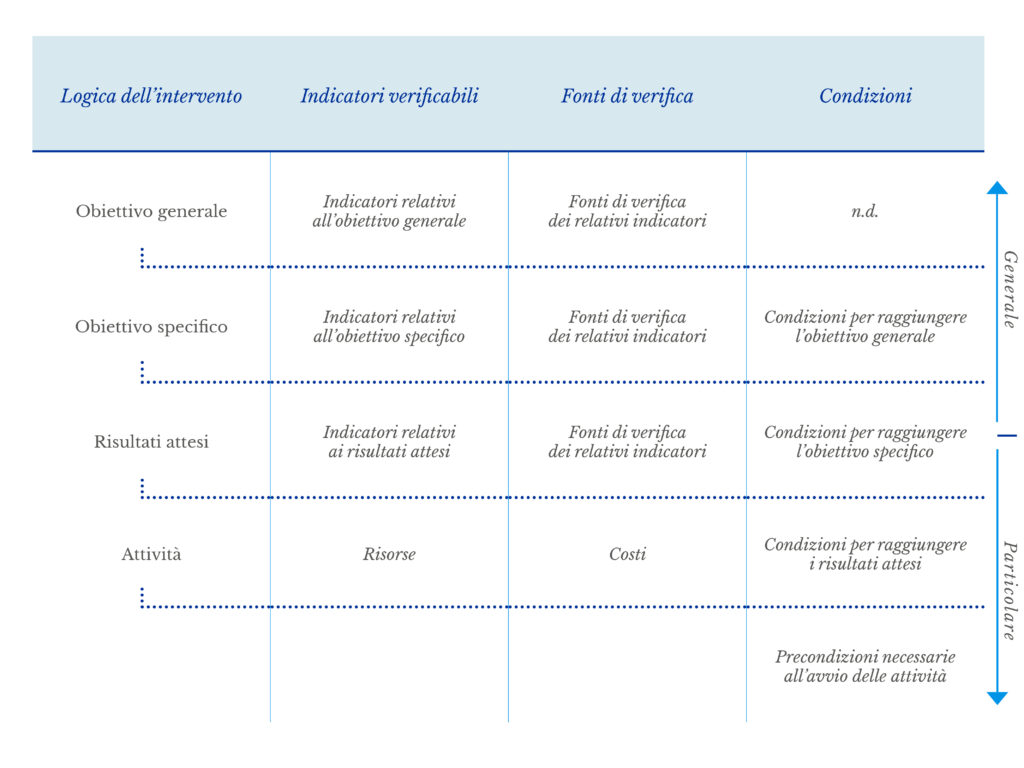
The upper right column of the logical framework is left blank: in fact, it carries the abbreviation “n.d.” (not available) in the proposed scheme. In a logical framework, the conditions indicate what is needed, along with what is provided by the project intervention logic, to accomplish what is provided at the next, more general level. The expected results are achieved due to the activities and the occurrence of certain conditions, indicated alongside the activities; the specific objective is achieved due to the results and certain conditions, indicated alongside the results; and so on. Since there is no level after the overall goal, there is no need to indicate conditions alongside the overall goal.
[3] For more:
The process of developing a logical framework does not necessarily follow the order of this description. The description provided in this chapter proceeds logically, from the most general level to the most particular level, from the definition of the intervention logic to the more specific aspects. The process for defining a logical framework, on the other hand, described in the next chapter, may follow a different order: it includes problem and solution analysis, context and stakeholder analysis, defining an intervention strategy, and others.
A logical framework can be read from top to bottom and left to right, from general to particular, as proposed in the description below. However, it can also be read from the bottom up and from left to right, from the particular to the general: this alternative reading order allows the chaining and coherence of the project logic to be followed from the most specific aspects. The examples below illustrate the main senses of reading a logical framework. Both senses of reading are useful and complementary to structuring a project.
[4] This aspect will be further explored in a section on defining the intervention strategy.
[5] For more:
The more extensive versions of the logical framework, which we will see at the end of the next chapter devote ad hoc columns to these dimensions, to make clear baseline and target-value of each indicator (with reference year of these values) and the value of the indicator at specific points in the life of the project(current value), emphasizing their importance.
This increased attention responds to the consolidation of practices and processes in the world of Europrojecting and the need to monitor and prove as rigorously as possible the achievement of project objectives and results: an attitude that is incumbent on EU and national institutions, taxpayers, beneficiary communities and organizations active in the same field.
[6] The lengthy process of debating, reviewing and approving the community budget (devoted mostly to program funding) bears full witness to this. Here a in-depth discussion of this issue.
x
3.3
How to structure a project: the process and tools
The design idea: let’s put it to the test
Access to community funding starts with the formulation of an initial project idea, which can arise from very different kinds of assessments. For example:
from responding to a specific need of businesses, civil society or institutions in a local organisations;
from the realization of a scientific research, artistic product or business idea;
by the desire to intensify interchanges with other parties to expand the use of information, experience and best practices.
Establishing a good design idea is of paramount importance for the subsequent development of the project. It in turn requires a number of important preliminary activities:
The collection of context-related information;
The formulation of the rationale for the intended action;
The analysis of one’s degree of ability in presenting and managing the project;
The collection of information and analysis of what has already been done in the same field, in Europe and in the local organisations;
reflection on the possibility of producing a significant impact on the beneficiaries, in line with what the funders require;
The reconnaissance of funding sources and the structuring of a sustainable project.
The European Commission (and more generally the set of actors working in the field of funded projects) has equipped itself with a set of methodological tools for the design of projects, their monitoring and the evaluation of their results.
The “logical framework”
The soundness of a project idea can be assessed on the basis of the categories of the so-called “logical framework” of the intervention (logical framework), one of the most important tools for europlanning.
The development of the logical framework is one of the first steps in the design activity and allows much of the analytical work necessary for the formulation of the actual design to be summarized in a single document. This document then becomes the basis for evaluating its progress and achievements in execution.
The essential structure of the logical framework is given below. The different categories it uses are defined and analyzed in the following paragraphs.
The logical framework
The first column of the logical framework identifies the logic of the intervention, i.e., the set of objectives, outcomes and activities that illustrate the operational strategy of the project. Subsequent columns serve to flesh out the intervention and serve as the basis for monitoring.
The following is a description of the different elements of the logical framework. More specifically:
The next section defines the levels of the intervention logic;
The following paragraphs define the columns for indicators, sources of verification and conditions.
Structuring the logic of the intervention
Intervention logic:OVERALL OBJECTIVE
Definition: project’s contribution to broader political and strategic impact (IMPACT).
Example:
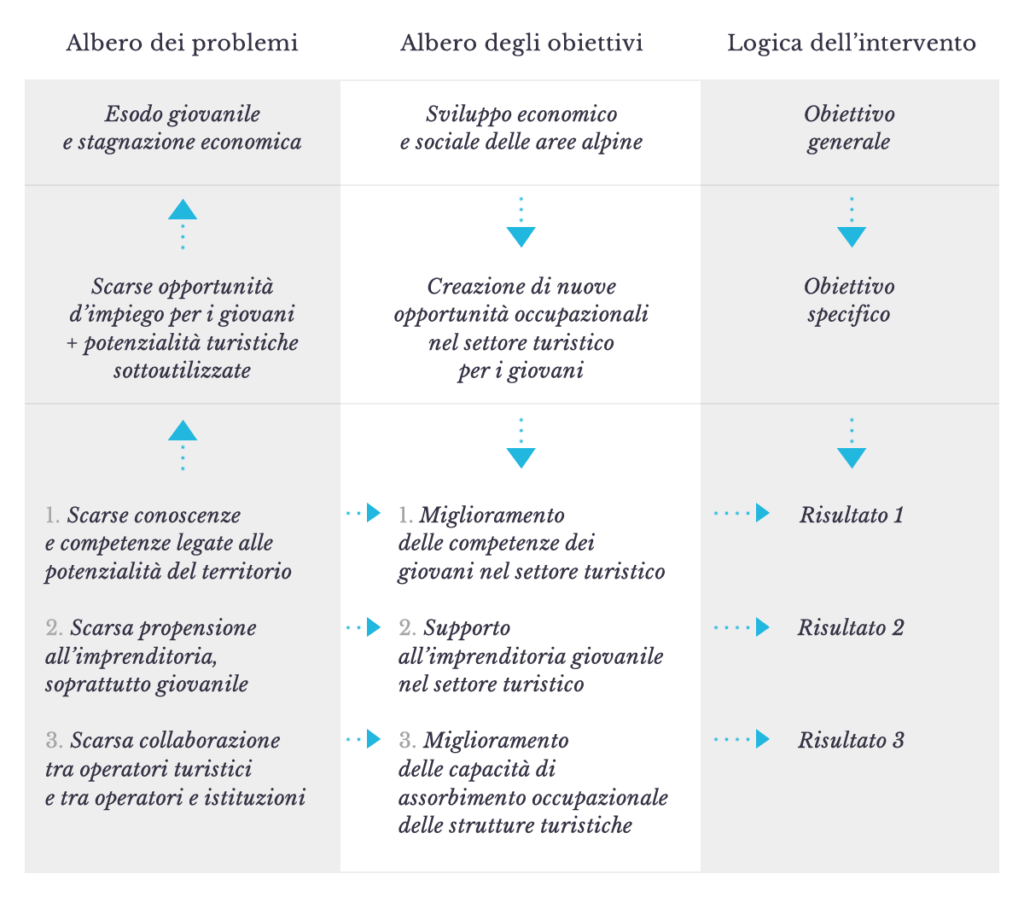
Promoting the economic and social development of Alpine areas.
Key questions:
What is the overall impact you want to create?
Is it consistent with regional, national, and European priorities?
Advice:
Clearly identify target area and population.
Check consistency with the strategic needs of local organisations.
Avoid duplication with other interventions.
Intervention logic:SPECIFIC OBJECTIVE
Definition: the outcome resulting from the implementation of the project (OUTCOME).
Example:
Create new employment opportunities in the tourism sector for young people in Alpine areas.
Key questions:
What problem does the project address?
What need of the beneficiaries does it respond to?
Advice:
Accurately identify the ultimate beneficiaries.
Verify the achievability of the goal.
Make sure it is consistent with the overall goal.
Logic of the intervention:EXPECTED RESULTS
Definition: what the project actually produces (OUTPUT).
Examples:
Improving the skills of young people in the tourism sector.
Stimulating youth entrepreneurship.
Improve the employment absorption capacity of the tourism sector.
Key questions:
What concrete results are needed to achieve the goal?
How is the problem articulated in its different dimensions?
Advice:
Choose relevant and realistic results.
Ensure consistency between results and specific goal.
Ensure that each outcome is achievable and measurable.
Logic of intervention:ACTIVITIES
Examples:
Training courses for unemployed youth.
Promotion of local language and culture teaching.
Microcredit schemes.
Helpdesk for young entrepreneurs.
Internships and training programs with companies.
Strengthening local organisations’ social partners.
Key questions:
What activities are needed to achieve each result?
With what resources and in what time frame?
Advice:
Detail the activities comprehensively but not excessively.
Also consider their temporal distribution.
Verify the eligibility of the activities against the notice.
Completing the logical framework
The logical framework includes indicators, sources of verification, means, costs and conditions, which give concreteness and precision to the project description.
Indicators
Definition: measure achievement of goals or outcomes; must be objectively verifiable, with baseline and value-target.
Examples:
Impact: reduction of youth unemployment by X%.
Outcome: increased youth employment in the tourism sector.
Output: X new training programs, X trained youth.
Key questions:
Through what metrics do I measure achievement?
Are they measurable and verifiable?
Advice:
Prefer simple, relevant and accessible parameters.
Define baseline and target at an early stage.
Use different indicators for impact, outcome and output.
Sources of verification
Definition: documents and sources for measuring indicators.
Examples:
National and regional statistics.
Data from chambers of commerce.
Data from the Ministry of Education.
Internal data collection for the project.
Key questions:
What sources do I use? Are they reliable?
Who collects the data and how often?
Advice:
Prefer reliable documentary sources.
Limit the use of auto-generated data.
Means
Examples:
Technical and administrative team.
Teachers and trainers.
Halls and materials.
Infrastructure and accreditation.
Key questions:
What resources are needed?
Which ones are available internally?
Advice:
Define realistic and complementary means.
Costs
Examples:
Total project costs.
Co-financing of partners.
Income generated by the project.
Key questions:
Are the costs proportionate to the results?
Are they eligible and verifiable?
Advice:
Detail costs by activity.
Use accountable categories.
Conditions (Assumptions)
Examples:
Maintaining the attractiveness of local organisations.
Social and economic stability.
Stable regulatory framework.
Collaboration of territorial actors.
Key questions:
What external conditions affect the project?
How likely are they and how much do they impact?
Advice:
State relevant, realistic and non-redundant hypotheses.
Avoid conditions that are too risky.
From analysis to logical framework
A good project proposal requires a thorough analysis of the context, needs, problems and possible solutions. The most widely used tool is the SWOT (Strengths, Weaknesses, Opportunities, Threats) matrix.
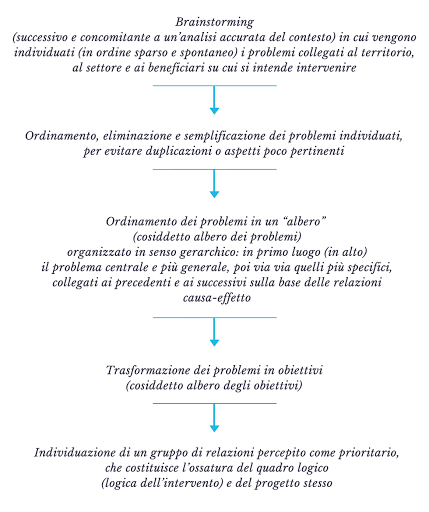
In the context of European funds, the most widely used tool for building project logic is theproblem tree,
together with the corresponding solution tree.
In the following example, the problem tree is transformed into thegoal tree,
which forms the backbone of the intervention logic.
PCM logic
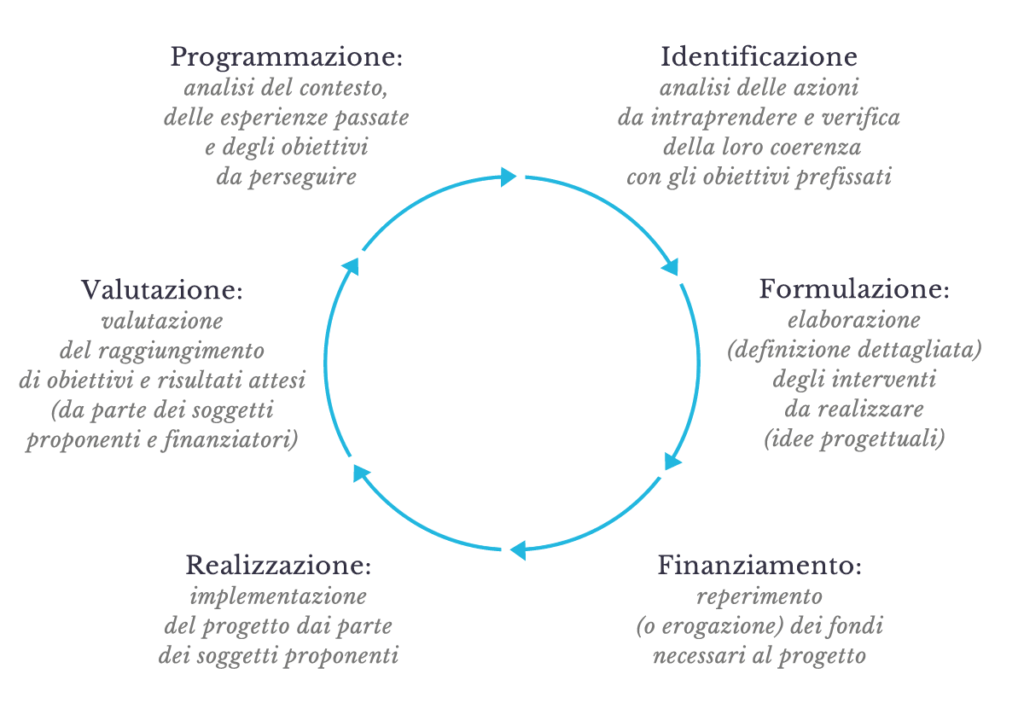
The use of the logical framework is associated with the PCM (Project Cycle Management) approach, which defines the key-stages of a project,
as explained in the Commission’s official guide.
In PCM logic, each stage is linked to the previous one and prepares for the next. It applies to both proposers and funders.
For proponents: prior analysis, evaluation and planning are crucial steps.
For funding agencies: European programs also follow a design logic, with evaluation, definition of objectives, results and activities.
Project activities contribute to broader program-level monitoring.
The goals of the project fit into larger scales (political, strategic, territorial).
The criteria for monitoring and evaluation
The criteria (relevance, efficiency, effectiveness, impact, sustainability) guide both the design and allocation of funding.
Criterion: Relevance
Meaning: appropriateness of project objectives to the call and context.
Where it applies: from context to actions.
Criterion: Efficiency
Meaning: quality and speed with which resources → activity.
Where it applies: in the quantification of resources.
Criterion: Effectiveness
Meaning: ability of the results to generate the specific goal.
Where it applies: from results to specific goal.
Criterion: Impact
Meaning: contribution of the project to the broader goals.
Where it applies: from the specific goal to the general goal.
Criterion: Sustainability
Meaning: ability of the project to produce lasting benefits.
Where it applies: across the whole project.