Let’s find out about the activities of Me.S.S.In.A Foundation, a civic and territorial development policy laboratory for the social economy
The Foundation of Sustainable and Supportive Mediterranean Communities for Inclusion and Welcoming (Fondazione Me.S.S.In.A.) is a Community Foundation that works with the aim of developing new models of social economy from a system perspective. A topic, that of social economy, which the Guide follows very closely with dedicated articles(here) and on which we have already shared some experiences.
Originating in the context of the Sicilian Spring, a period of civic movements in response to the Capaci and Via D’Amelio massacres, Fondazione Me.S.S.In.A has been active since 2010 to create an Evolved Social District in Messina and several local organisations and inland areas in Sicily. The Foundation is rooted in local organisations but has a global vision: it collaborates with local, global and European networks, with an approach aimed at developing broad policies and new models that can be replicated in other contexts.
Let’s find out together about its approach, activities and the challenges it faces at the local and European levels.We talk about it with Giacomo Pinaffo, secretary general of Fondazione Me.S.S.In.A.
Fondazione Me.S.S.In.A. is a community foundation, thus a local foundation, but one that is well aware of and active in addressing major global challenges. A foundation that is also “a case study,” like the Agrigento and Trapani Foundation, which we have already mentioned.
In what does your vision and specificity consist?
Our Foundation has a strong focus on the social economy, and was established with a broad objective: to design and implement sustainable development policies for local organisations, alternatives to traditional policies.
We therefore deal not so much with individual projects, but with activities that can involve different sectors, from manufacturing to urban regeneration, to many others. First and foremost, the Foundation leads a cluster ofsocial economy realities, which together contribute to designing and implementing an integrated development policy capable of involving all local organisations.
Born in the city of Messina, our Foundation now involves many towns in the inland areas of Sicily, in the provinces of Messina and Catania, along with international networks and partners. The name, Me.S.S.In.A. Foundation, is both a tribute to our homeland (Messina) and an acronym that contains our core values, which look to a broader horizon: “Me.S.S.In.A.” as Mediterranean, Sustainability, Solidarity, Inclusion and Welcoming.
Indeed, our challenge is to connect the local with the global. Working at the local level, our approach seeks to explore avenues that can be replicated and applied elsewhere. Sicily has particularly acute social and environmental problems: it is at the bottom of the European rankings in terms of employment rate, the number of families in poverty, and the share of local organisations at risk of desertification (as much as 70 percent). This also makes it an ideal laboratory for developing new policies on important issues, such as inequality and climate change.
Many of the policies we test become material for scientific articles, passing through international peer review by experts and then disseminated within international networks. This is because useful lessons learned here can also become useful in other contexts, in Europe and the Mediterranean.
You are active in so many areas: widespread parks, cultural heritage, industrial parks, microcredit and solidarity economy, urban redevelopment, inland areas and proximity welfare, energy and circular economy, social housing… and we have certainly not mentioned everything. Can you tell us about some experiences that you think are particularly significant?
One of the most interesting experiences is that of the Messina Brewery, which grew out of a workers buyout experience that the Me.S.S.In.A. Foundation incubated in its early stages. This is a historical brewery, the first brewery in Sicily, founded in 1923, which went bankrupt in 2013 and then reopened in 2014 by a group of workers, who created a new cooperative: since then the brewery has been in continuous activity and is connected to other development initiatives.
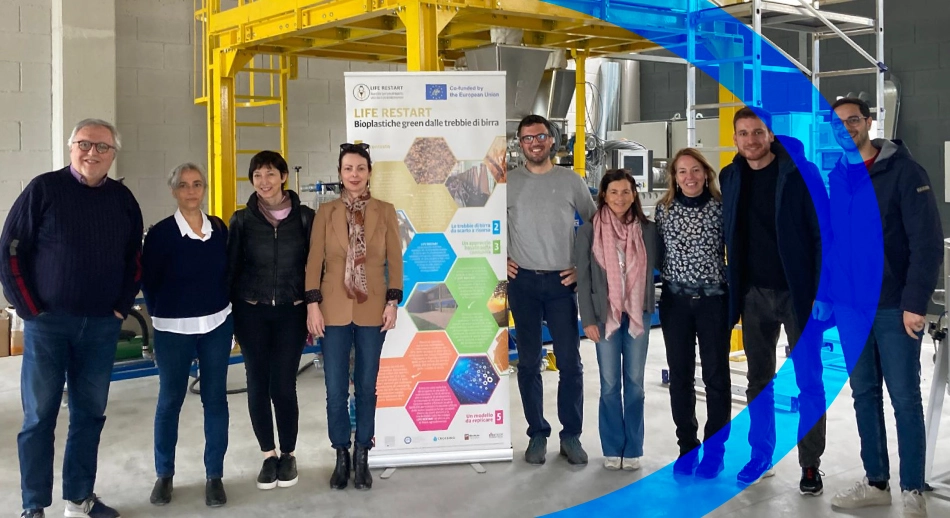
One of these initiatives is linked to a European project: the LIFE RESTART, funded by the LIFE program, carried out research and installation activities for a bioplastics production plant in Roccavaldina, an inland area of Messina with many abandoned industrial facilities, high depopulation rates and unemployment. The plant was inaugurated in 2025: it allows spent malt from the brewery to be used for the production of bioplastics and, given its context, is intended to be at the center of broader community development.
The municipality of Roccavaldina was also selected by the Borghi call launched by the Ministry of Culture under the PNRR, with the GHADAN Project. Thus even more synergies were created, with systemic actions around the factory on historic sites, sustainable mobility, renewable energy communities and more.
We see this as an excellent example of how different dots can be connected throughaction geared toward an ecosystem, a cluster, that is larger than a single project.
Another example? Me.S.S.In.A. Foundation won the CEB Award for Social Cohesion, an award from the Council of Europe’s development bank, with the Capacity program, an urban regeneration initiative for the southern suburbs of Messina where slums built after the 1908 earthquake still exist, degraded areas with the characteristics of ghetto neighborhoods.
The initiative has involved 205 families in an urban regeneration policy, which has led them to leave the slums and move into decent housing of their choice, with support for job placements and the emergence of undeclared work. The spaces freed from the slums host a large urban park, with bio-architectural structures integrating housing units, a library and a children’s center.
This place has also become a pilot site for testing innovations within various European projects as a test for innovative technologies, such as batteries developed by a Horizon Europe project called “Hybris,” to transform the area into an energy self-sufficient community with an innovative storage system that compensates for the continuity problem that characterizes renewable energy. The technological aspect was combined with an analysis of the social indicators of community members to go toward those who need it most. An additional Horizon Europe project(SOCIAREM) that has just begun will focus on ways to actively and participatively engage members of the energy community.
Many aspects of your activity are developed through European projects. How did you get started and how did you approach it?
Our experience is quite recent, we have been working with European projects for about 5 years. It is a very useful activity, both to create connections with other European actors, networks and partnerships with new actors and from other local organisations, and also because European projects stimulate a lot of innovation. As the Me.S.S.In.A. Foundation, we work on broad and combined programs, which also combine several projects, among which we have begun to include European ones. The more experiences we can get to interact the better, and collaboration in the Mediterranean also comes through Europe.
The first European project in which we participated was GIMED, an ENI CBC MED European territorial cooperation project in the Mediterranean area, with a focus on incubating and supporting entrepreneurs, particularly young people and women, in the eco-innovation sector in Spain, Lebanon, Palestine, Tunisia, Egypt and Italy.
We will definitely continue to participate in calls of this kind, because they fully reflect our goal of connecting the local with the global, of welcoming and experimenting with new policies.
Due to the very large size of the projects, which also involve non-EU countries, we participate mainly as partners.
In terms of the partners we started working with at the European level, the report on social and environmental innovation published by the GECES (Commission Expert Group on the Social Economy and Social Enterprises), an expert group charged with advising the European Commission on policies related to the social economy. In the report, not only is the new social economy cluster model identified, but also many case studies of such clusters existing in Europe are cited. This allowed various actors in Europe to recognize each other and establish contacts, creating collaborations with other clusters.
Among our partners in the Mediterranean, we work extensively with MedWaves, a Regional Activity Center of the United Nations Environment Program (UNEP/MAP) born out of the Barcelona Convention for the Protection of the Mediterranean, which works for international cooperation in the Mediterranean on Sustainable Consumption and Production (SCP) models.
With them we carried out the European project SOFIGREEN: Social Finance for Social Greening., funded by the COSME program. The project has supported small and medium-sized social economy enterprises in Europe, North Africa and the Middle East with capacity building activities to support them in the ecological transition of processes and activities, with support for investment readiness and raising the finance needed to make the leap forward, interacting with broader spatial ecosystems.
Then there is the LIFE-RESTART, which we have already mentioned: it has enabled us to initiate the transformation of spent malt into bioplastics, and we were the coordinator.
What are you “reaping” from your participation in European projects? How are you structuring yourselves and what is your advice for those who want to take this path?
European planning is of great interest to us as a funding opportunity for the policies we develop and as an opportunity for innovation, but activating European planning in just 5 years is not an easy process from an organizational point of view. It is a long journey, in which we “cut our teeth” slowly, studying procedures and documentation to move from theory to practice.
Therefore, in most cases we collaborate as partners, offering ourselves as coordinators only in projects where we have a very specific project idea. It is important to collaborate with partners who already have experience, to avoid adding to the administrative burden.
Partnership is critical. Both for the initial design, to present a solid project, but also for the later management part: unsound partners risk compromising the project. And in the case where you are project coordinator, you will have to compensate for the difficulties with additional effort.
Therefore, it is important to do a good screening and analysis of potential partners. In our case, the European networks, such as REVES, the European network of cities and regions for the social economy, and FEBEA, the European federation of cooperative ethical banks, have been instrumental in gaining access to partners spread across countries that can be mobilized. Partners also bring prior knowledge, which if well integrated into the partnership can generate a real “snowball effect” in a positive way.
Another aspect to pay close attention to is the administrative aspect, which requires specific attention, staff capable of managing, reading regulations, and supporting partners in adapting and producing the required material (for example: for calculating personnel costs as required). Therefore, it is important to activate internal trainings, create templates, and organize specific calls with partners to integrate and adapt the differences between countries into one management system.
Preparation and first steps are crucial, and in this your Guide can be of great help. One must first begin to “digest” how European funds work. Study the programs, annual work programs, look at sample calls to understand how calls are structured, eligibility criteria, budget structure. Keeping in mind that not all European projects go through the Funding&Tenders portal, but can be launched “cascading” from other programs and projects.
These first steps allow one to identify the opportunities best suited to one’s needs and areas of activity. And subsequently, to identify partners and individuals to work with, starting with one’s own referral networks.
The rest is patience, good will, strategy and investment of time.