
Let’s explore how to combine European funding, sustainable mobility, and smart data use, drawing on the experience of Pin Bike
The Challenge of Sustainable Mobility and the Value of Data
Can a financial incentive change people’s behavior toward more active and sustainable mobility? Can the smart use of data enable a startup to make a name for itself in the world of European projects?
This is the challenge taken on by Pin Bike: an Italian SME that, thanks to the development of certified and—as they say—“data-driven” technology, has succeeded in transforming cycling mobility into an urban policy that can be scaled across Europe.
Through the stories of Nico Capogna, founder and CEO of Pin Bike, and Annarita Leserri, Project Manager, we discover how the synergy between design expertise and European funds makes it possible to overcome “car dependency,” bringing concrete solutions from the streets of Bari all the way to the heart of the European Union’s environmental policies.
Let’s start with Nico and cover the basics: What is Pin Bike, and what does it do?
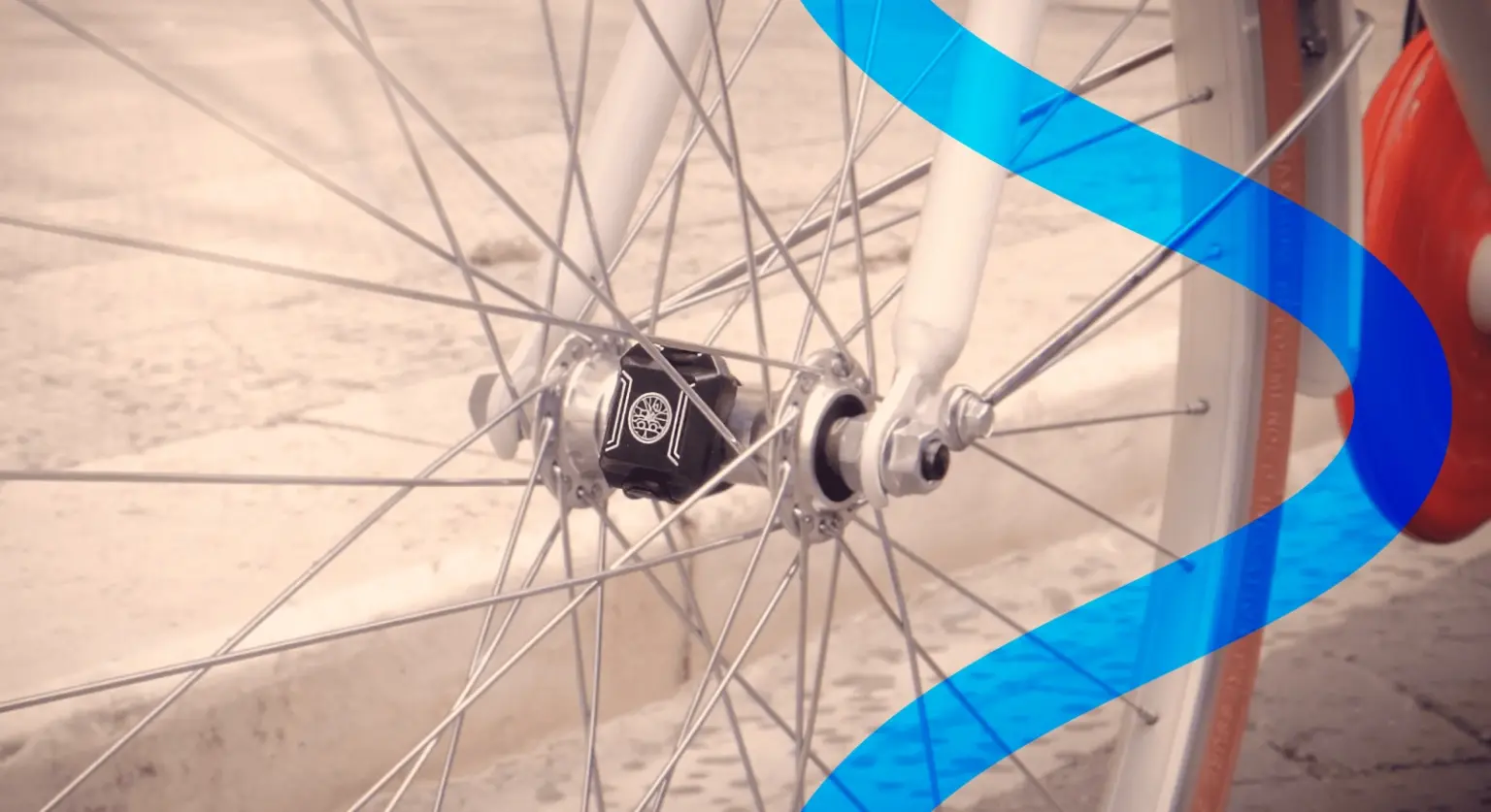
Pin Bike was founded as a startup in 2017 to transform citizens’ approach to sustainable mobility by encouraging the use of bicycles for daily commutes. To achieve this, we developed a patented technology that combines two elements: a small tracking device installed directly on the bicycle, and an app that records the kilometers traveled and the routes taken by the user.
Through certified monitoring, the system prevents data from being altered or falsified and transforms the collected information into a valuable“portfolio” of mobility data. The kilometers traveled can be converted into financial incentives, provided by municipal governments to their citizens, or by employers to employees who bike to work. The collected data is invaluable for providing local governments with insights into mobility and urban planning. Pin Bike is also certified to the highest quality and security standards (ISO 9001 and ISO 27001), ensuring the integrity of our work with data and local governments.
Our idea didn’t stem from a “business” motivation, but from the goal of accelerating the shift from motor vehicles to bicycle mobility in urban areas—a choice that’s good for your health, the environment, and your wallet. Our financial incentive system stems from the “ethical” goal of changing citizens’ behavior in a way that benefits the community.
To date, Pin Bike has more than 30,000 users across Europe, who have cycled nearly 13 million km, prevented the emission of 2,000 metric tons of CO2, and earned more than 2.5 million euros. The results are tangible and immediate: the European REACTIVITY project in Lecce and Braga (Portugal) has demonstrated, thanks to Pin Bike, an increase in active mobility of up to 15% and a reduction in car use of up to 8%.
Can you tell us how your idea came about?
The idea behind Pin Bike came from two different experiences.
The first one took place a few years ago, back in 2010. I was a student in Rome and got around mostly by public transportation. I ended up—partly by chance and partly by fate—sharing a house with some “bike activists,” or rather, people who ran community bike repair shops. They gave me a bike, and the first thing I thought was that they were crazy: Rome, with its cobblestones, traffic, and stressed-out drivers, seemed like an unlikely place to start biking. But despite everything, after a first month of somewhat clumsy attempts, I started to get the hang of it, and the bike became my main mode of transportation. From that moment on, the bike was always by my side during my next six years in Rome—a city that can even feel small when you ride a bike. It was this very personal experience that sparked my love for urban cycling, which combines utility and practicality. A love that I’ve tried to share and promote—though not always successfully.
The second idea came to me a few years later, when I went to visit a friend in Belgium. He told me that he earned 50 euros a month for biking to work, as part of his employer’s sustainability policies, even though there was no system in place to track his trips.
Pin Bike was born out of these two experiences, based on the idea that financial incentives are a means of promoting and scaling up sustainable actions more easily by changing people’s behavior. In a world that needs a bit of a “push” toward change, fines alone aren’t enough; there must also be incentives—which, however, must be verified and certified.
The name “Pin Bike,” on the other hand, was inspired by my return to my hometown, Corato, in the province of Bari, where a call for proposals for young entrepreneurs had been launched, called “Pugliesi INnovativi”: PIN, to be exact. I didn’t let this chance slip by, and Pin Bike was born from this opportunity. Here, “Pin” refers both to the hardware (which is shaped like a large “pin”) and to the “pin” that virtually tracks us on a map to record our bike trips.
Let’s move on to another important milestone in your journey: when and why did you start working on European projects?
At first, we were driven by curiosity—the same curiosity that led to the creation of Pin Bike. Pin Bike was inspired by a trip to Belgium, and in the same way, European projects encourage you to step outside your own borders and discover new ideas and opportunities. From the very beginning, Pin Bike has had a “European” approach and aspiration: sustainable mobility knows no borders and is a topic close to the hearts of people in all European countries.
One of our first opportunities to work with European funds came through our participation in the 2021–2022 EIT Urban Mobility call for proposals. The range of funds and programs we’ve turned to has expanded over the years (ESF+, Horizon Europe, etc.), and this has been crucial for securing resources for potential clients, particularly public administrations. In fact, we have a long list of municipalities that would like to implement Pin Bike, so we at Pin Bike often step in to help these municipalities secure the funding needed to get the project off the ground. Often, once the project ends, the municipalities extend the initiative using their own funds.
So, part of our history with European projects involves securing funding for our clients. But it’s also essential for us to participate in European projects as partners, because it strengthens our ability to innovate. Pin Bike can highlight its innovative features thanks to the data it tracks: certified, high-quality data on the use of bike paths and roads, collected from the rides of more than 30,000 users.
In addition to the dedicated web dashboard for local governments, Pin Bike provides an open data platform featuring aggregated and anonymized data from all users. This wealth of data allows us to position ourselves as credible stakeholders in projects related to mobility, urban planning, and urban policy. Many European projects aim to promote solutions and best practices that have already proven successful: it is important to be able to demonstrate that we have implemented actions that have a positive impact, backed by data. This is a major advantage for us when participating in European projects. It allows us to keep pace withthe growing focus on data use and to apply the concept of smart cities not only in technological terms but also in terms of planning and active citizen participation.
Annarita is the person in charge of European projects at Pin Bike. What were your first steps, the first surprises, and the first challenges you faced in European project planning?
The first major challenge was to build out our staff, because managing European projects requires dedicated personnel. That’s why I joined Pin Bike, bringing with me previous experience as a European project manager in Barcelona, where I managed European projects—especially Horizon projects—specifically in the field of mobility.
Our approach to European projects cannot be that of a “project mill”: European projects are just one of our activities. We are, first and foremost, a company that offers solutions and products regardless of the source of funding—whether European, national, regional, or even private. When we decide to pursue a European project and apply for funding, it is because we want to develop something new—to drive an innovative enhancement that has a positive impact on our business from a commercial, scientific, and strategic standpoint. Examples include the integration of multimodal transportation (micromobility, public transit, carpooling) into our monitoring and gamification mechanisms, the integration of AI elements into our technological system, and the development of new IoT devices. We do this based on extensive, real-world data that we collect, certify, organize, and use as a starting point and baseline for our projects.
This aspect of our work allows us to take European design theories and practices seriously. The first step in any project—and one we always take—is to establish a baseline, or initial data. We expect this data to improve as a result of our work, and we monitor it regularly, with a midterm review and a final evaluation. At Pin Bike, we systematically apply this process precisely because the collection and analysis of certified data form the foundation of our work. This is required and highly valued, particularly in European projects, and it makes these projects successful, impactful, and “communicable” to the public by the local governments that benefit from them.
The solutions developed by Pin Bike in European projects can vary widely.
For example, most of the cities we work with—such as Bari, Brescia, Florence, and Turin, but also Istanbul and Tallinn—are interested in reducing vehicle traffic and increasing the share of urban travel by bicycle. However, cities like Turku, in Finland, or Braga, in Portugal, want to co-create city maps with residents to involve them in the decision-making process or collect data to better plan their network of bike lanes. Furthermore, some cities, such as Bergamo, Monza, and Stockholm, choose to involve local merchants in their projects as well: the financial incentives earned by Pin Bike users can be spent exclusively in local stores, thereby supporting local businesses and extending participation in behavioral change to the entire community. In any case, wherever Pin Bike is used, the solution we propose addresses a specific problem facing the city and the community that has adopted it.
The important thing in all these cases is that the objective be clear: to determine whether the goal being pursued—and which is to be measured—is to involve people in participatory processes, reduce traffic, improve urban planning, or reduce pollution. This is another somewhat“textbook”aspect when it comes to European project design, but one that we take seriously and that is appreciated.
Returning to the challenges we faced in our early days of European project design, one major challenge certainly involved our so-called“track record”: when we started, Pin Bike had no portfolio of completed European projects, and the reach of our solution was still limited. This creates a barrier to entry: it’s neither easy nor immediate to build a “track record” and establish credibility. The seriousness of our approach allowed us to demonstrate and document with data what we were doing, and it helped us greatly in bridging the gap and carrying out our first European projects.
What are your new challenges and, above all, what are the new prospects for Pin Bike at the European level?
Pin Bike is increasingly establishing itself as a recognized player in the field of sustainable urban mobility, not only in Italy but also at the European level. Its expertise is promoted by European organizations and networks such as the European Cyclists’ Federation (ECF) and Cycling Industry Europe (CIE). In their advocacy guidance document for member states and in a dedicated interview, both organizations highlight Pin Bike as a best-practice model.
Certainly, we must take into account the resources of the Social Climate Fund—the European fund financed through pollution taxes—which was designed to support the segments of the population most affected by climate change and energy poverty. From this perspective, the bicycle becomes a powerful tool capable of compensating for the shortcomings of public transportation and, therefore, also a means of reducing inequality.
In this context, there is no longer a clear distinction between Italian and European dynamics; therefore, the goal is to participate more and more actively in large-scale projects within the framework of Horizon Europe and other EU initiatives. Looking ahead, the challenge is no longer to prove that the model works—the data already show that. It is to institutionalize it, and this can only be achieved by working together with all stakeholders (public administrations, businesses, universities, and individuals) involved in the challenge of sustainable mobility.
Pin Bike is constantly looking for partners—local governments, universities, research centers, and businesses—with whom to develop project proposals on active mobility, urban data, and climate transition.
Anyone interested in exploring a collaboration is welcome to contact us.