Distribution of resources by strategic and specific objective
PR distribution
* PR Resources
%
Strategic Goals, Specific Objectives and Areas of Focus
ERDF:
5.858.950.301 €
100%
ESF+:
1.515.590.676 €
100%
* Total resources (EU contribution + national contribution). The allocation by specific objective and intervention sector is indicative (it proportionally resumes the allocation given by the ROP on the EU contribution). Small discrepancies are possible due to rounding.
Develop and strengthen research and innovation capabilities and the introduction of advanced technologies
002
75.167.416 €
1%
Investment in fixed assets, including research infrastructure, in small and medium-sized enterprises (including private research centers) directly related to research and innovation activities
004
37.583.709 €
1%
Investment in fixed assets, including research infrastructure, in public research centers and public higher education directly related to research and innovation activities
006
12.527.903 €
0%
Investment in intangible assets in SMEs (including private research centers) directly related to research and innovation activities
010
91.983.829 €
2%
Research and innovation activities in SMEs, including networking activities
011
10.220.426 €
0%
Research and innovation activities in large enterprises, including networking activities
024
21.428.571 €
0%
Advanced support services for SMEs and SME groups (including management, marketing, and design services)
025
17.857.143 €
0%
Incubation, support for spin offs, spin outs and start-ups
030
30.060.074 €
1%
Processes of research and innovation, technology transfer and business-to-business cooperation focused on the circular economy
1.ii.
161.135.781 €
3%
Enable citizens, businesses, research organizations and public authorities to reap the benefits of digitization
013
12.857.143 €
0%
Digitization of SMEs (including e-commerce, e-business and networked business processes, digital innovation hubs, living labs, web entrepreneurs, ICT start-ups and B2B)
016
94.571.429 €
2%
ICT solutions, electronic services, applications for administration
019
19.428.571 €
0%
E-health applications and services (including e-Care, Internet of Things for physical activity, home automation for vulnerable groups)
026
5.142.857 €
0%
Support for innovation clusters, including between enterprises, research organizations and public authorities, and networks of enterprises mainly for the benefit of SMEs
036
19.428.571 €
0%
ICT: other types of ICT infrastructure (including large-scale IT resources/facilities, data centers, sensors, and other wireless instrumentation)
170
9.707.210 €
0%
Improving the capacity of program authorities and bodies related to the implementation of the Funds
1.iii.
463.618.737 €
8%
Strengthening sustainable growth and competitiveness of SMEs and job creation in SMEs, including through productive investment
021
239.333.023 €
4%
SME business development and internationalization, including productive investment
024
30.000.000 €
1%
Advanced support services for SMEs and SME groups (including management, marketing, and design services)
025
71.428.571 €
1%
Incubation, support for spin offs, spin outs and start-ups
069
42.857.143 €
1%
Commercial and industrial waste management: measures for prevention, minimization, sorting, reuse, and recycling
075
80.000.000 €
1%
Support for environmentally friendly production processes and resource efficiency in SMEs
1.iv.
28.269.434 €
0%
Develop skills for smart specialization, industrial transition and entrepreneurship
023
28.269.434 €
0%
Developing skills for smart specialization, industrial transition, entrepreneurship and business adaptability to change
Promoting energy efficiency and reducing greenhouse gas emissions
040
100.000.000 €
2%
Energy efficiency and demonstration projects in SMEs or large enterprises and support measures in accordance with energy efficiency criteria
044
105.000.000 €
2%
Renewal of public infrastructure for the purpose of energy efficiency or energy efficiency-related measures for such infrastructure, demonstration projects and support measures
045
45.000.000 €
1%
Renovation of public infrastructure for the purpose of energy efficiency or energy efficiency-related measures for such infrastructure, demonstration projects, and support measures in accordance with energy efficiency criteria
170
10.078.804 €
0%
Improving the capacity of program authorities and bodies related to the implementation of the Funds
2.ii.
271.848.770 €
5%
Promote renewable energy in accordance with Directive (EU) 2018/2001, including the sustainability criteria set forth therein
048
100.000.000 €
2%
Renewable energy: solar
049
11.848.770 €
0%
Renewable energy: biomass
052
150.000.000 €
3%
Other types of renewable energy (including geothermal energy)
053
10.000.000 €
0%
Smart energy systems (including smart grids and ICT systems) and related storage
2.iii.
90.000.000 €
2%
Develop smart energy storage systems, networks and facilities outside the Trans-European Energy Network (TEN-E)
053
90.000.000 €
2%
Smart energy systems (including smart grids and ICT systems) and related storage
060
26.000.000 €
4%
Climate change adaptation measures, prevention, and management of climate-related risks: other, e.g., storms and droughts (including outreach, civil protection and disaster management systems, infrastructure, and ecosystem-based approaches)
2.iv.
344.887.110 €
6%
Promote climate change adaptation, disaster risk prevention, and resilience by considering ecosystem approaches
058
175.000.000 €
3%
Climate change adaptation measures, prevention and management of climate-related hazards: floods and landslides (including outreach, civil protection, disaster management systems, infrastructure, and ecosystem-based approaches)
059
92.500.000 €
2%
Climate change adaptation measures, climate-related risk prevention and management: fire (including awareness raising, civil protection and disaster management systems, infrastructure, and ecosystem-based approaches)
060
5.000.000 €
0%
Climate change adaptation measures, prevention, and management of climate-related risks: other, e.g., storms and droughts (including outreach, civil protection and disaster management systems, infrastructure, and ecosystem-based approaches)
061
67.500.000 €
1%
Prevention and management of non-climate-related natural hazards (e.g., earthquakes) and human-related hazards (e.g., technological accidents), including outreach, civil defense and disaster management systems, infrastructure, and ecosystem-based approaches
170
4.887.110 €
0%
Improving the capacity of program authorities and bodies related to the implementation of the Funds
2.v.
260.078.804 €
4%
Promoting access to water and its sustainable management
062
43.769.701 €
1%
Water supply for human consumption (extraction, treatment, storage and distribution infrastructure, water efficiency measures, drinking water supply)
063
8.753.940 €
0%
Provision of water for human consumption (extraction, treatment, storage and distribution infrastructure, water efficiency measures, drinking water supply) in accordance with efficiency criteria
064
80.000.000 €
1%
Water resources management and conservation (including watershed management, specific climate change adaptation measures, reuse, leakage reduction)
065
105.047.283 €
2%
Wastewater collection and treatment
066
17.507.880 €
0%
Collection and treatment of wastewater in accordance with energy efficiency criteria
170
5.000.000 €
0%
Improving the capacity of program authorities and bodies related to the implementation of the Funds
2.vi.
254.424.917 €
4%
Promoting the transition to a circular and resource-efficient economy
067
192.068.687 €
3%
Household waste management: measures for prevention, minimization, sorting, reuse and recycling
068
34.913.737 €
1%
Household waste management: treatment of residual waste
069
22.442.493 €
0%
Commercial and industrial waste management: measures for prevention, minimization, sorting, reuse, and recycling
170
5.000.000 €
0%
Improving the capacity of program authorities and bodies related to the implementation of the Funds
2.vii.
152.654.950 €
3%
Strengthen the protection and preservation of nature, biodiversity and green infrastructure, including in urban areas, and reduce all forms of pollution
073
15.000.000 €
0%
Reclamation of industrial sites and contaminated land
078
80.000.000 €
1%
Protection, restoration and sustainable use of Natura 2000 sites.
079
55.000.000 €
1%
Protection of nature and biodiversity, natural heritage and resources, green and blue infrastructure
170
2.654.950 €
0%
Improving the capacity of program authorities and bodies related to the implementation of the Funds
Develop an intermodal, safe, smart, climate change resilient and sustainable TEN-T network
100
182.886.046 €
3%
Reconstructed or modernized railway lines – core TEN-T network
105
5.000.000 €
0%
European rail traffic management system (ERTMS)
108
10.000.000 €
0%
Multimodal Transportation (TEN-T)
3.ii.
932.891.361 €
16%
Develop and strengthen smart, intermodal, climate-resilient, and sustainable local, regional, and national mobility, including improving access to the TEN-T network and cross-border mobility
083
30.000.000 €
1%
Cycling infrastructure
090
10.000.000 €
0%
Other newly constructed or renovated national, regional, and local access roads
093
132.857.143 €
2%
Other reconstructed or upgraded roads (highways, national, regional or local roads)
094
10.000.000 €
0%
Digitization of transportation: roads
102
177.962.790 €
3%
Other railway lines rebuilt or modernized
103
260.714.286 €
4%
Other rebuilt or modernized rail lines – electric/zero emission
104
5.000.000 €
0%
Digitization of transportation: rail lines
107
212.857.143 €
4%
Mobile railway infrastructure with zero emissions/electricity
112
88.500.000 €
2%
Other seaports
118
5.000.000 €
0%
Safety and air traffic management systems, for existing airports
Improve equal access to quality and inclusive education, training, and lifelong learning services through the development of accessible infrastructure, including by promoting the resilience of online and distance education and training
018
10.428.571€
0%
IT applications and services for digital skills and digital inclusion
122
148.726.910 €
3%
Infrastructure for primary and secondary education
123
63.000.000 €
0%
Infrastructure for tertiary education
124
4.000.000 €
0%
Infrastructure for vocational education and training and adult learning
4.iii.
113.077.741 €
2%
Promote the socioeconomic inclusion of marginalized communities, low-income families, and disadvantaged groups, including people with special needs, through integrated actions, including housing and social services
126
33.923.323 €
1%
Housing infrastructure (other than for migrants, refugees, and persons applying for or enjoying international protection)
127
33.923.323 €
1%
Other social infrastructure that contributes to social inclusion in the community
143
45.231.096 €
1%
Measures to promote work-life balance, including through access to childcare and dependent care
4.v.
118.731.629 €
2%
Ensure equal access to health care and promote the resilience of health care systems, including primary health care, as well as promote the transition from institutional to family-based and community-based care
128
77.175.559 €
1%
Infrastructure for health care
129
23.746.326 €
0%
Sanitary equipment
130
11.873.163 €
0%
Movable health goods
131
5.936.581 €
0%
Digitization of health care
4.vi.
67.846.644 €
1%
Strengthen the role of culture and sustainable tourism in economic development, social inclusion and social innovation
127
13.000.000 €
0%
Other social infrastructure that contributes to social inclusion in the community
165
34.846.644 €
1%
Protection, development and promotion of public tourism assets and tourism services
166
20.000.000 €
0%
Protection, development and promotion of cultural heritage and cultural services
Promote integrated and inclusive social, economic and environmental development, culture, natural heritage, sustainable tourism and safety in urban areas
016
14.285.714 €
0%
ICT solutions, electronic services, applications for administration
018
1.428.571 €
0%
IT applications and services for digital skills and digital inclusion
036
14.285.714 €
0%
ICT: other types of ICT infrastructure (including large-scale IT resources/facilities, data centers, sensors, and other wireless instrumentation)
058
21.428.571 €
0%
Climate change adaptation measures, prevention and management of climate-related hazards: floods and landslides (including outreach, civil protection, disaster management systems, infrastructure, and ecosystem-based approaches)
063
22.857.143 €
0%
Provision of water for human consumption (extraction, treatment, storage and distribution infrastructure, water efficiency measures, drinking water supply) in accordance with efficiency criteria
067
22.857.143 €
0%
Household waste management: measures for prevention, minimization, sorting, reuse and recycling
079
68.571.429 €
1%
Protection of nature and biodiversity, natural heritage and resources, green and blue infrastructure
122
7.142.857 €
0%
Infrastructure for primary and secondary education
126
11.428.571 €
0%
Housing infrastructure (other than for migrants, refugees, and persons applying for or enjoying international protection)
143
7.142.857 €
0%
Measures to promote work-life balance, including through access to childcare and dependent care
165
57.068.106 €
1%
Protection, development and promotion of public tourism assets and tourism services
166
71.428.571 €
1%
Protection, development and promotion of cultural heritage and cultural services
168
121.428.571 €
2%
Material upgrading and safety of public spaces
169
2.857.143 €
0%
Spatial development initiatives, including the development of spatial strategies
170
8.100.000 €
0%
Improving the capacity of program authorities and bodies related to the implementation of the Funds
5.ii.
169.616.611 €
3%
Promote locally integrated and inclusive social, economic, and environmental development, culture, natural heritage, sustainable tourism, and safety in areas other than urban areas
016
1.428.571 €
0%
ICT solutions, electronic services, applications for administration
018
1.428.571 €
0%
IT applications and services for digital skills and digital inclusion
036
1.428.571 €
0%
ICT: other types of ICT infrastructure (including large-scale IT resources/facilities, data centers, sensors, and other wireless instrumentation)
048
5.714.286 €
0%
Renewable energy: solar
049
5.714.286 €
0%
Renewable energy: biomass
053
5.714.286 €
0%
Smart energy systems (including smart grids and ICT systems) and related storage
058
4.285.714 €
0%
Climate change adaptation measures, prevention and management of climate-related hazards: floods and landslides (including outreach, civil protection, disaster management systems, infrastructure, and ecosystem-based approaches)
059
4.285.714 €
0%
Climate change adaptation measures, climate-related risk prevention and management: fire (including awareness raising, civil protection and disaster management systems, infrastructure, and ecosystem-based approaches)
060
4.285.714 €
0%
Climate change adaptation measures, prevention, and management of climate-related risks: other, e.g., storms and droughts (including outreach, civil protection and disaster management systems, infrastructure, and ecosystem-based approaches)
061
1.428.571 €
0%
Prevention and management of non-climate-related natural hazards (e.g., earthquakes) and human-related hazards (e.g., technological accidents), including outreach, civil defense and disaster management systems, infrastructure, and ecosystem-based approaches
063
7.142.857 €
0%
Provision of water for human consumption (extraction, treatment, storage and distribution infrastructure, water efficiency measures, drinking water supply) in accordance with efficiency criteria
067
5.714.286 €
0%
Household waste management: measures for prevention, minimization, sorting, reuse and recycling
078
7.857.143 €
0%
Protection, restoration and sustainable use of Natura 2000 sites.
079
10.714.286 €
0%
Protection of nature and biodiversity, natural heritage and resources, green and blue infrastructure
122
2.857.143 €
0%
Infrastructure for primary and secondary education
143
2.857.143 €
0%
Measures to promote work-life balance, including through access to childcare and dependent care
165
14.285.714 €
0%
Protection, development and promotion of public tourism assets and tourism services
166
14.285.714 €
0%
Protection, development and promotion of cultural heritage and cultural services
167
31.516.611 €
1%
Protection, development and promotion of natural heritage and ecotourism other than Natura 2000 sites
168
25.714.286 €
0%
Material upgrading and safety of public spaces
169
2.857.143 €
0%
Spatial development initiatives, including the development of spatial strategies
170
8.100.000 €
0%
Improving the capacity of program authorities and bodies related to the implementation of the Funds
Improve access to employment and activation measures for all job seekers, particularly young people, especially through the implementation of the Youth Guarantee, the long-term unemployed and disadvantaged groups in the labor market, as well as inactive people, including through the promotion of self-employment and the social economy
134
160.944.817 €
11%
Measures to improve access to employment
135
40.102.530 €
3%
Measures to promote access to employment for the long-term unemployed
137
12.832.810 €
1%
Support for self-employment and business start-ups
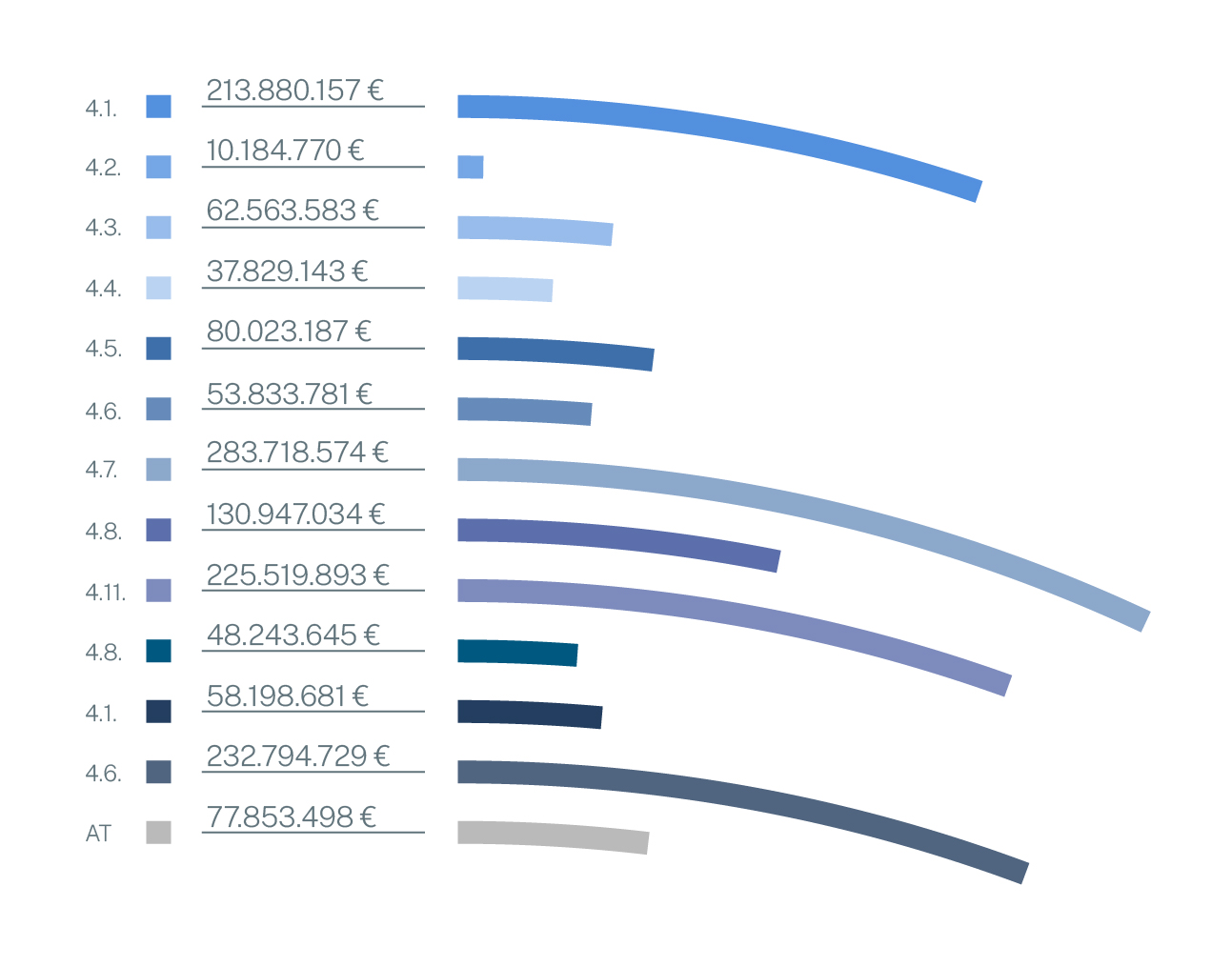
4.2.
10.184.770 €
1%
Modernize labor market institutions and services to assess and anticipate skills needs and ensure timely and tailored assistance and support in the context of matching supply and demand, labor market transitions and mobility
139
4.583.147 €
0%
Measures to modernize and strengthen labor market institutions and services to assess and anticipate skill needs and to ensure timely and ‘targeted assistance
140
5.601.623 €
0%
Supporting job matching and labor market transitions
4.3
62.563.583 €
4%
Promote gender-balanced labor market participation, equal working conditions, and better work-life balance, including through access to affordable childcare and dependent care services
137
20.020.346 €
1%
Support for self-employment and business start-ups
142
33.784.336 €
2%
Measures to promote women’s participation in the labor market and reduce gender segregation in the labor market
143
8.758.901 €
1%
Measures to promote work-life balance, including through access to childcare and dependent care
4.4.
37.829.143 €
2%
Promote the adaptation of workers, enterprises and entrepreneurs to change, active and healthy aging, as well as a healthy and appropriate work environment that takes into account health risks
144
5.296.080 €
0%
Measures to create healthy and appropriate work environments that take into account health risks and promote physical activity
146
32.533.063 €
2%
Support for the adaptation of workers, businesses and entrepreneurs to change
Improving the quality, inclusiveness, effectiveness and labor market relevance of education and training systems, including through the validation of nonformal and informal learning, to support the acquisition of key competencies, including entrepreneurial and digital skills, and promoting the introduction of dual training systems and apprenticeships
145
6.401.856 €
0%
Supporting the development of digital skills
149
59.217.157 €
4%
Support for primary and secondary education (excluding infrastructure)
151
9.602.783 €
1%
Support for adult education (excluding infrastructure)
152
4.801.391 €
0%
Measures to promote equal opportunities and active participation in society
4.6.
53.833.781 €
4%
Promote equal access to and completion of inclusive and quality education and training, particularly for disadvantaged groups, from early childhood education and care, through general and vocational education and training, to the tertiary level and adult education and learning, including facilitating mobility for the purpose of learning for all and accessibility for people with disabilities
148
53.833.781 €
1%
Support for early childhood education and care (excluding infrastructure)
149
41.021.341 €
3%
Support for primary and secondary education (excluding infrastructure)
4.7.
283.718.574 €
19%
Promote lifelong learning, particularly opportunities for skill level upgrading and flexible retraining for all, taking into account entrepreneurial and digital skills, better anticipating change and new skill demands based on labor market needs, facilitating career reorientation, and promoting occupational mobility
146
21.278.893 €
1%
Support for the adaptation of workers, businesses and entrepreneurs to change
150
112.352.556 €
7%
Support for tertiary education (excluding infrastructure)
151
150.087.126 €
10%
Support for adult education (excluding infrastructure)
Encourage active inclusion, to promote equal opportunity, nondiscrimination and active participation, and improve employability, particularly of disadvantaged groups
137
3.928.410 €
0%
Support for self-employment and business start-ups
152
83.806.101 €
6%
Measures to promote equal opportunities and active participation in society
153
24.879.937 €
2%
Pathways to integration and reintegration into the world of work for the disadvantaged
154
9.166.293 €
1%
Measures to improve the access of marginalized groups such as the Roma to education and employment and to promote their social inclusion
156
9.166.293 €
1%
Specific actions to increase the participation of third-country nationals in employment
4.11.
225.519.893 €
15%
Improve equal and timely access to quality, sustainable, and affordable services, including services that promote access to housing and person-centered care, including in health care; modernize social protection systems, including by promoting access to social protection, paying particular attention to children and disadvantaged groups; improve accessibility, including for people with disabilities, the effectiveness and resilience of health care systems and long-term care services
148
14.658.791 €
1%
Support for early childhood education and care (excluding infrastructure)
157
18.041.591 €
1%
Measures aimed at the social integration of third-country nationals
159
52.546.136 €
3%
Measures to strengthen the provision of support services to families and in the local organisations
160
122.457.303 €
8%
Measures to improve the accessibility, effectiveness, and resilience of health systems (excluding infrastructure)
162
17.816.071 €
1%
Measures to modernize social protection systems, including promoting access to social protection
Encourage active inclusion, to promote equal opportunity, nondiscrimination and active participation, and improve employability, particularly of disadvantaged groups
137
2.412.181 €
0%
Support for self-employment and business start-ups
153
18.211.976 €
2%
Pathways to integration and reintegration into the world of work for the disadvantaged
156
23.156.950 €
2%
Specific actions to increase the participation of third-country nationals in employment
170
4.462.538 €
0%
Improving the capacity of program authorities and bodies related to the implementation of the Funds
Improve access to employment and activation measures for all job seekers, particularly young people, especially through the implementation of the Youth Guarantee, the long-term unemployed and disadvantaged groups in the labor market, as well as inactive people, including through the promotion of self-employment and the social economy
134
25.607.420 €
2%
Measures to improve access to employment
136
32.591.261 €
2%
Specific support for youth employment and socio-economic integration of young people
4.6.
232.794.729 €
15%
Promote equal access to and completion of inclusive and quality education and training, particularly for disadvantaged groups, from early childhood education and care, through general and vocational education and training, to the tertiary level and adult education and learning, including facilitating mobility for the purpose of learning for all and accessibility for people with disabilities
149
232.794.729 €
15%
Support for primary and secondary education (excluding infrastructure)
PR ESF Managing Authority: Regional Department of Education and Vocational Training – viale Regione Siciliana 33, 90139 Palermo.dgiubilaro@regione.sicilia.ittel secretariat 091 7073154 – 091 7073018
RDP Managing AuthorityRegional Department of Agriculture – Area 4 “Coordination and Management of the Rural Development Plan” – 2771 Sicilian Region Avenue, 90145 Palermo.psrsicilia@regione.sicilia.it -agri.areacoordinamentopsr@regione.sicilia.it – agri.assistenzatecnicapsr@regione.sicilia.it
PR ESF SICILY
Approved by the European Commission on December 17.2014
Purpose
ESF investments in Sicily target education, skills and social inclusion, with the aim of achieving sustainable and inclusive growth.
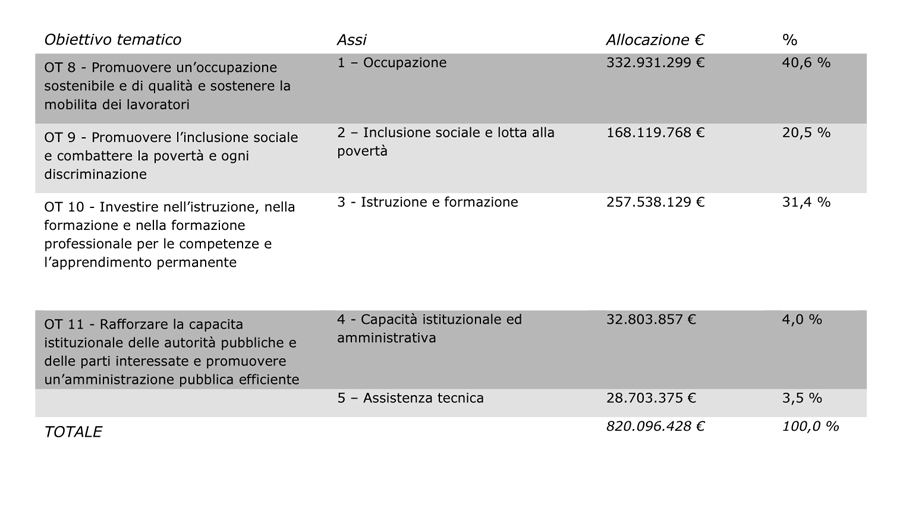
The operational program (OP) of the’ ESF for the Sicily region will target education, employability and social inclusion as priority areas. The OP has a total budget of 820 million euros, and investments up to 2020 are expected to boost sustainable and inclusive growth and contribute for the region to meet national and EU goals regarding employment and society.
The ESF program for Sicily has identified three main investment priorities:
more than 40 percent of funding will go to projects that boost job opportunities through better skills and qualifications. A particular goal is a higher employment rate among NEET youth and women; in addition, employment services will be modernized to better meet the needs of job seekers;
social inclusion measures will receive 20 percent of available funding and will target disadvantaged people and those on the margins of society, helping them to access the labor market and improve their living standards;
Continued improvements in education and training will be supported. Higher levels of qualification, wider access to learning opportunities, and specialized courses and training more relevant to the labor market and targeted to the needs of the local economy will be promoted. A significant reduction in the number of young people leaving school early without a qualification will be achieved. Lifelong learning as a means of improving one’s career opportunities will be promoted to the island’s population-more than 30 percent of available funding has been allocated to this area.
In addition, Sicily will invest in the skills and expertise of its civil servants to ensure that they know how to manage and deliver employment programs for the benefit of citizens.
Eligible subjects and partnership
Beneficiaries may be different, depending on the type of action and call for proposals: businesses, public entities, social cooperatives, public and private educational and scholastic institutions, universities, training institutions, public and private research organizations, technological districts, bilateral entities, public and private employment services, guidance centers, entities accredited for guidance, vocational training and employment services activities, trade representations, local public administrations, instrumental bodies of the Sicilian Region, third sector and associationism enterprises, social enterprises and cooperatives, voluntary associations, LAGs, local authorities, regional administration, care services, families and employers of disadvantaged and disabled people, care services, Health Authorities, Socio-Health Districts, regional administration and judicial bodies. The notices define the eligibility of beneficiaries.
Thematic reference goals
8. Promote sustainable and quality employment and support worker mobility
9. Promoting social inclusion and combating poverty and all discrimination
10. Investing in education, training and vocational training for skills and lifelong learning
11. Strengthen the institutional capacity of public authorities and stakeholders to promote efficient public administration
Priority axes
Axis 1 – EmploymentAxis 2 -Social inclusion and poverty alleviationAxis 3 – Education and trainingAxis 4- Institutional and administrative capacityAxis 5 – Technical assistance
Axis 1 – Employment
8.IAccess to employment for job seekers and inactive people, including the long-term unemployed and people on the margins of the labor market, as well as through local employment initiatives and job mobility support
8.II Sustainableintegration into the labor market of young people, particularly those not in employment, education or training, including youth at risk of social exclusion and youth from marginalized communities, including through the implementation of the Youth Guarantee
8.IVEquality between men and women in all areas, including access to employment and career progression, work-life balance, and promotion of equal pay for equal work or work of equal value
8.VIIModernization of labor market institutions, such as public and private employment promotion services, by improving the fulfillment of labor market needs, including through actions that improve transnational job mobility as well as through mobility programs and better cooperation between institutions and stakeholders.
Axis 2 – Social inclusion and poverty alleviation.
9.IActive inclusion, including promoting equal opportunities and active participation, and improving employability
9.IV Improved access to affordable, sustainable and quality services, including social services and health care in the general interest;
Axis 3 – Education and Training
10.I Reducing and preventing earlyschool leaving and promoting equal access to good quality preschool, primary, and secondary education, including formal, nonformal, and informal learning pathways to resume education and training
10.IIImproving the quality and effectiveness of and access to higher and equivalent level education to increase participation and success rates, especially for disadvantaged groups
10.III Strengthen equal access to lifelong learning for all ages in formal, nonformal and informal settings, update the knowledge, skills and competencies of the workforce, and promote flexible learning pathways including through career pathway guidance and recognition of acquired skills
10.IV Improving the relevance of education and training systems to the labor market, facilitating the transition from education to the world of work, and strengthening and vocational education and training systems and improving their quality, including through skill anticipation mechanisms, adaptation of curricula, and the introduction and development of work-based learning programs, including dual learning and apprenticeship systems
Axis 4 – Institutional and administrative capacity
11.I Invest in the institutional capacity andefficiency of public administrations and public services at the national, regional and local levels with a view to reforms, better regulation and good governance.
Financial allocation
Total resources PR ESF Sicily (EU resources and regional and national co-financing): € 820,096,428
Approved by the European Commission on August 17, 2015
Purpose
The Sicilian Region jointly orients the PR ERDF Sicily 2014-2020, other operational programs financed by the EIS funds, national resources for regional development, and other relevant funds to address in an integrated way some key challenges for Sicily: boosting employment, growth, and social cohesion; increasing competitiveness; enhancing territorial, environmental, and cultural resources as drivers of expected development; improving the quality of life of citizens, including through the pursuit of greater territorial cohesion; and improving the ecosystem and making services more efficient and accessible. The starting context in which these challenges are set is very complex: the severe problems hindering the growth of the regional system and the social cohesion of the Sicilian community have been made more severe in recent years by the harshness of the international crisis grafted onto the structural deficits present in the region.
The program thus aims to create growth and jobs by boosting innovation and competitiveness and improving the efficient use of resources. Shares the goals outlined in the Europe 2020 strategy for smart, sustainable and inclusive growth. The program aims to increase the competitiveness of SMEs, strengthen research and innovation and ICT, protect the environment, promote resource efficiency, and develop transportation networks. It will ultimately help improve energy efficiency in the region and the transition to a low-carbon economy.
Eligible subjects and partnership
Beneficiaries may be different, depending on the type of action and call: Corporations, Start-ups, SMEs, Business Networks, Large Enterprises, Science and Technology Parks and Districts, Health Corporations, Public and Private Entities, Bodies and Foundations, Public Administrations, Educational Institutions, Public-Private Partnerships, Public Service Managers, Nonprofits and the Third Sector. The notices define the eligibility of beneficiaries.
Thematic reference goals
1. Strengthening research, technological development and innovation
2. Improving access to and use and quality of information and communication technologies
3. Competitiveness of Small and Medium Enterprises, the Agricultural Sector (for EAFRD) and the Fisheries and Aquaculture Sector (for EMFF).
4. Supporting the transition to a low-carbon economy.
6. Preserve and protect the environment and promote the efficient use of resources
7. Promoting sustainable transportation and improving network infrastructure
9. Promote social inclusion and fight against poverty and any discrimination
10. Investing in education, training and lifelong learning
Priority axes
Axis 1 – Research, Technological Development and InnovationAxis 2 – Digital AgendaAxis 3 – Competitiveness of Small and Medium Enterprises, the Agricultural Sector and the Fisheries and Aquaculture SectorAxis 4 – Sustainable Energy and Quality of Life.Axis 5 – Climate Change, Risk Prevention and Management.Axis 6 – Protecting the Environment and Promoting the Efficient Use of Resources.Axis 7 -Sustainable Transportation Systems.Axis 9 – Social InclusionAxis 10 – Education and training
Investment Priority
Below is the detail of investment priorities for each of the axes priority.
Axis 1 – Research, Technological Development and Innovation
1(a)Strengthen research and innovation (R&I) infrastructure and capacities to develop excellence in R&I as well as promote centers of expertise, particularly those of European interest.1(b)Promote business investment in R&I by developing linkages and synergies between enterprises, R&D centers, and the higher education sector, especially investment in product and service development, technology transfer, social innovation, eco-innovation, applications in public services, demand stimulation, networks, clusters, and open innovation through smart specialization, as well as supporting technological and applied research, pilot lines, early product validation actions, advanced manufacturing capabilities and first production especially of key enabling technologies, and dissemination of general purpose technologies.
Axis 2 – Digital Agenda
2(a) Expand the deployment of broadband and high-speed networks and support the adoption of future and emerging networks and technologies in the digital economy;
2(b ) Develop ICT products and services, electronic commerce, and ICT demand.
2(c) Strengthen ICT applications for e-government, e-learning, e-inclusion, e-culture and e-health.
Axis 3 – Competitiveness of Small and Medium Enterprises, the Agricultural Sector and the Fisheries and Aquaculture Sector
3(a) Promote entrepreneurship, particularly by facilitating the economic exploitation of new ideas and promoting the creation of new companies, including through business incubators;
3(b ) Develop, implement new business models for SMEs, especially for internationalization;
3(c ) Support the creation and expansion of advanced capabilities for product and service development;
3(d ) Support the ability of SMEs to engage in growth in regional, national and international markets and innovation processes.
Axis 4- Sustainable Energy and Quality of Life
4(a) Promote the production and distribution of energy from renewable sources
4(b ) Promoting energy efficiency and renewable energy use in enterprises
4(c ) Support energy efficiency, smart energy management, and renewable energy use in public infrastructure, including public buildings, and the housing sector
4(d ) Develop and implement intelligent distribution systems operating at low and medium voltage
4(e) Promote low-carbon strategies for all types of local organisations, particularly urban areas, including the promotion of sustainable multimodal urban mobility and adaptation measures aimed at emissions mitigation.
Axis 5 – Climate Change, Risk Prevention and Management.
5(b ) Promote investments designed to address specific risks, ensure disaster resilience, and develop disaster management systems
Axis 6 – Protecting the Environment and Promoting the Efficient Use of Resources.
6 (a) Investing in the waste sector to meet the obligations under the Union’s environmental acquis and meet the needs, as identified by member states, for investment beyond these obligations
6 (b) Investing in the water resources sector to meet the Union’s aquis environmental obligations and meet the needs, identified by member states, for investments beyond those obligations
6 (c ) Preserve, protect, promote and develop natural and cultural heritage
6 (d) Protect and restore biodiversity and soils, and promote ecosystem services, including through Natura 2000 and by means of green infrastructure
6 (e) Take action to improve the urban environment, revitalize cities, redevelop and decontaminate brownfield sites (including redevelopment sites), reduce air pollution, and promote noise reduction measures
6 (f) Promote innovative technologies to improve environmental protection and efficient use of resources in the areas of waste, water, and with regard to soil or to reduce air pollution
Axis 7 – Sustainable transportation systems.
7(b ) Improve regional mobility by connecting secondary and tertiary nodes to the TEN-T infrastructure, including multimodal nodes;
7 (c) Develop and improve environmentally friendly (including low-noise) and low-carbon transport systems, including inland waterway and maritime transport, ports, multi-modal connections, and airport infrastructure, in order to foster sustainable regional and local mobility.
Axis 9 – Social Inclusion
9(a) Invest in health and social infrastructure in a way that contributes to national, regional and local development, the reduction of disparities in health conditions, the promotion of social inclusion through improved access to social, cultural and recreational services as well as the transition from institutional to local services
9(b) Providing support for the physical, economic and social regeneration of disadvantaged communities in urban and rural areas
Axis 10 – Education and Training
10(a) Investing in education, training and vocational training for skills and lifelong learning by developing school and training infrastructure
Financial allocation
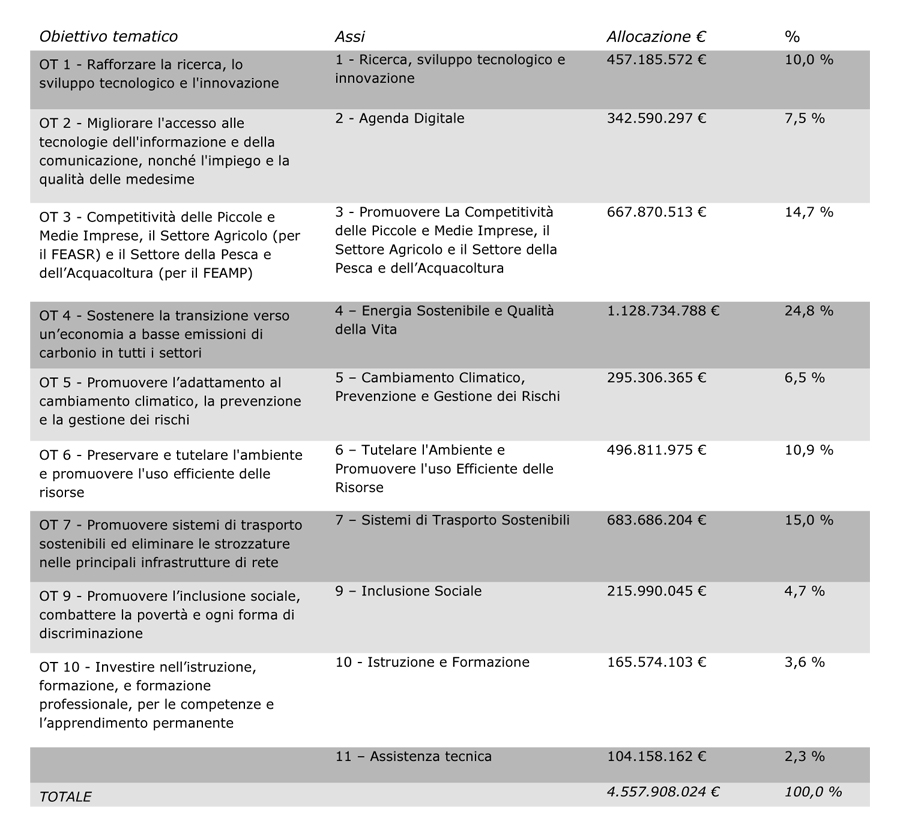
Total resources PR ERDF Sicily (EU resources and regional and national co-financing): € 4,557,908,024
Approved by the European Commission on November 24, 2015
Purpose
The rural development program for Sicily places special emphasis on actions related to strengthening the competitiveness of the agricultural and forestry sector and the preservation, restoration and enhancement of ecosystems, as well as actions aimed at promoting social inclusion and economic development in rural areas. The Sicily RDP will finance actions under all six rural development priorities, with a focus on preserving, restoring and enhancing ecosystems related to agriculture and forestry as well as strengthening the competitiveness of the agricultural sector and promoting social inclusion and economic development in rural areas. Specifically, the program identifies the following main objectives:
Increasing the profitability and economic size of agricultural enterprises, targeting stable enterprises and encouraging forms of association, in order to improve business efficiency market orientation, increase added value and production quality;
Encourage the creation, start-up and development of agricultural and non-agricultural entrepreneurial activities, especially generational renewal;
To encourage integration in supply chains, the level of concentration of supply, organizational and process innovations, to facilitate market access and internationalization of quality production, with particular reference to organic;
Preserve and enhance biodiversity, conserve and improve soil quality, and defend the local organisations from hydrogeological disruption and surface erosion, including through forestry sector interventions;
Improve infrastructure, development of production systems (crafts, services, tourism, ICT), including through local development strategies, to promote the permanence of the working population in the local organisations.
Eligible subjects and partnership
Beneficiaries may be different, depending on the type of action and call. The main beneficiaries are: Providers of training, demonstration, information, advisory and knowledge transfer services (public or private), Farmers, family helpers, Foresters, Groups of Farmers (natural or legal persons), Associations of farmers and/or producers, micro/SMEs and large enterprises, Public Entities, Municipalities, Local Authorities, Administrations, Public and/or Private Institutions, Temporary Purpose Associations, Land Management Entities, Public-Private Partnerships, Sicilian Region, NGOs and organizations working in the environmental, landscape and tourism sectors, Owners, Public Owners and/or Holders of the management of agricultural and forestry land, Cooperative Groups, Local Action Groups (LAGs). The notices define the eligibility of beneficiaries.
Priority
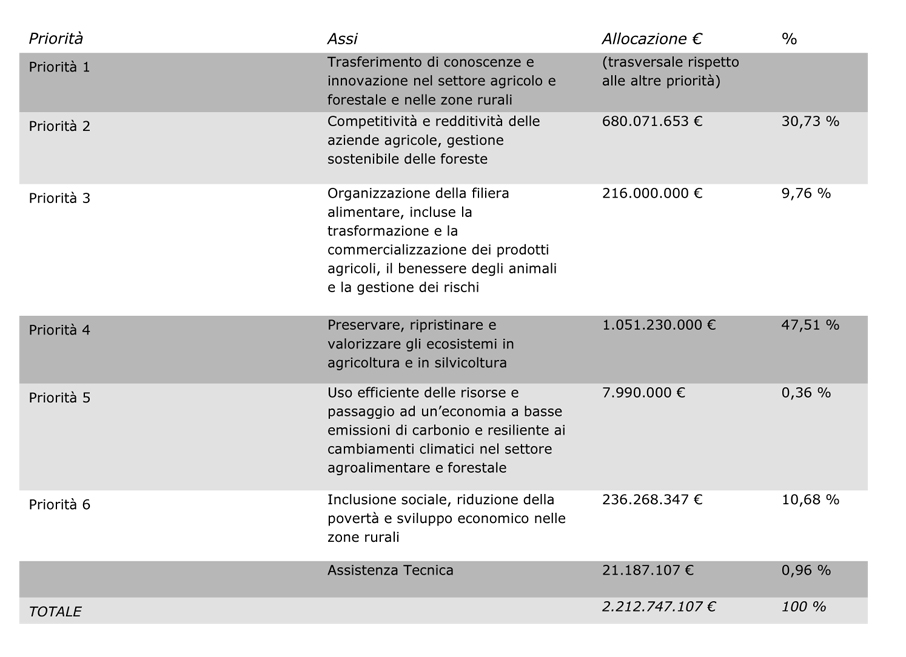
Priority 1: Knowledge transfer and innovation in agriculture and forestry and rural areas.
Priority 2: Competitiveness and profitability of farms, sustainable forest management
Priority 3: Promote the organization of the food chain, including the processing and marketing of agricultural products, animal welfare and risk management
Priority 4: Preserve, restore and enhance ecosystems related to agriculture and forestry
Priority 5: Encouraging resource efficiency and the transition to a low-carbon and climate-resilient economy in the agribusiness and forestry sector
Priority 6: Promoting social inclusion, poverty reduction and economic development in rural areas
Focus Area
Below is the detail from the area focuses for each of the priority axes .
Priority 1
1A Stimulateinnovation, cooperation and development of the knowledge base in rural areas;
1B Strengthen the links between agriculture, food production and forestry, on the one hand, and research and innovation, on the other, also with a view to improving environmental management and performance;