Managing aquatic resources with European projects: winning experiences for European biodiversity calls for proposals
If this summer we told you about European projects and sea protection, now we tell you about an experience that speaks instead of fresh water. For our Stories section, we “dove” into a local context, that of Lake Maggiore, to tell you about the experience of the CNR’sInstitute for Research on Water (CNR-IRSA) and how European funds are integrated into their scientific and technological research and support for water and biodiversity management, creating a bridge between the local and European dimensions.
We discuss this from the perspective of LIFE projects, Europe’s main biodiversity program, whose future in the EU’s next budget is uncertain as of today (we discussed it here and here).
The CNR-IRSA consists of 5 locations throughout Italy (Brugherio, Montelibretti, Bari, and Taranto Verbania) that deal with the topic of water from different perspectives: from the integrated and sustainable management of water and its biological resources, to the biodiversity of aquatic ecosystems; from water purification, to the remediation of contaminated sites and the circular economy.
Let’s discover together the experience of the Verbania (VCO) office with Pietro Volta, researcher and ichthyologist at CNR-IRSA since 2011.
The Institute for Research on Water (IRSA) is concerned with a unique and irreplaceable resource. How?
The Verbania office was founded as the Italian Institute of Hydrobiology in the early 1900s, characterizing itself by research and monitoring activities on freshwaters, with a typically holistic approach. A lake or watercourse, in fact, is made up of abiotic and biotic components. To understand its functioning, therefore, it is necessary to know all the individual parts that then interact with each other.
The Verbania office became part of the National Research Council in the second half of the 1970s, and recently became part of the Institute for Research on Water (IRSA), which follows and expands the theme of theoretical and applied freshwater research to include such aspects as purification and ecotoxicology.
Staff expertise covers water physics and chemistry and the study of biological components (plankton, aquatic plants, fish, sediments). The leitmotif of our institute has always been “know to manage,” that is, to provide the knowledge necessary for informed management of surface water bodies, groundwater and aquatic resources.
Your “projects” page is thick with names and content. How do projects (and especially European projects) become part of your activity?
Yes, there is a lot of “water under the fire.” The research activities of IRSA, and of the Verbania office in particular, have recently had a great boost thanks to the arrival of many young researchers. Topics such as the study and conservation of biodiversity have found fertile ground to interact positively with the historical core of expertise already present in our Institute, related to freshwater. And projects are the driving force behind our research activities. In particular, we always try to combine the different competencies in projects with a strong applied research component, so that even in the short term we can “measure” the results. This is especially true for projects that aim to improve the conservation status of biodiversity, and that have the concrete goal of supporting the management and protection of lakes and streams.
European projects are a fundamental part of our research activities, both theoretical and applied. They are really the heart that enables the functioning of all institutes and the research world, because they guarantee resources for activity. State revenues are limited, and so, resources from European funds and Foundations, are central to ensuring a continuity of action and results. They are a substantial “slice” of the research “cake,” not just “icing.”
European projects, then, are the most important because they also make it possible to broaden horizons, approaches and areas of research, as has happened in our experience with the topic of biodiversity. This kind of research allows theoretical principles to be declined into concrete activities on the local organisations, to draw guidelines for the management of resources and ecosystems in our local organisations. Results that are then transferred to decision-making bodies that should make the best use of them.
Your first European project was HydroLIFE, on the topic of aquatic biodiversity and blue corridors, at the local level. Would you like to tell us about how it came about, what difficulties you had to overcome, and what positive developments it brought to your activity?
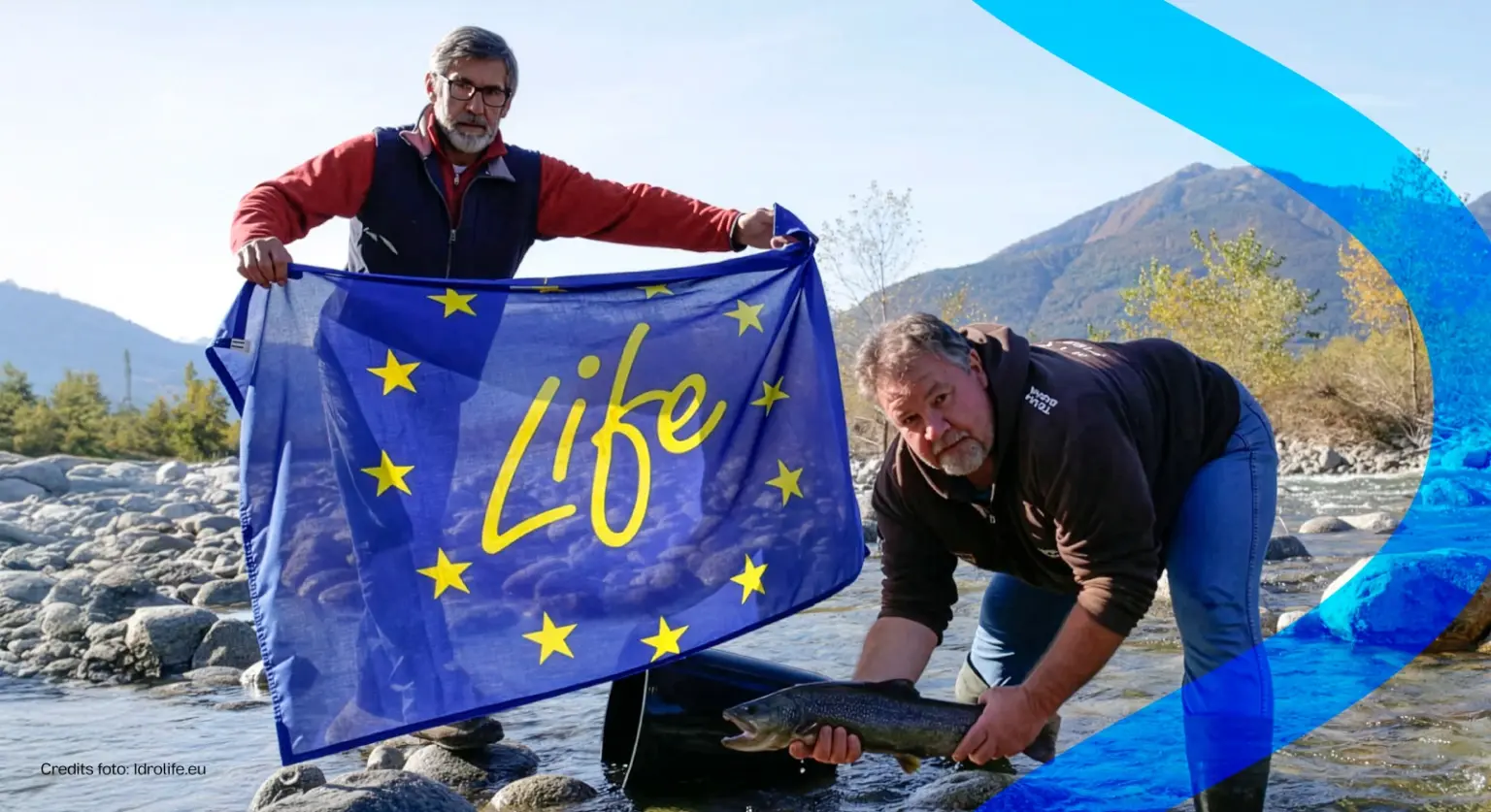
It was the first large-scale European project that we followed directly as the Verbania office, with the role of coordinators. Between 2016 and 2022, it made it possible to decline locally, in the local organisations of the VCO, some cardinal principles of European policies on nature protection and biodiversity. The project partnership was a mix of public and private entities: in addition to CNR IRSA, the VCO Province, the Val Grande National Park Authority and GRAIA srl, an environmental consulting firm, were partners.
The project aimed to improve the conservation status of some fish species and freshwater crayfish listed in the Habitats Directive as species to be protected and whose conservation status should be implemented. The project was focused on the entire province of VCO, with a special emphasis on protected areas belonging to the Natura 2000 Network.
The project’s strategy was multifaceted and included both direct species restocking efforts and river defragmentation measures along the Toce River and the San Bernardino Stream (construction of fish passages), as well as extensive environmental education activities with young people and outreach to the local community and key stakeholders (fishermen). The project’s planned works were completed, and a self-sustaining mechanism was established through which restocking continues to this day—even after the project’s conclusion—in collaboration with fishermen’s associations.
The greatest challenges involved coordinating the implementation timelines of the various project partners—particularly those within the public administration—with the specific requirements of the European Union. All major outcomes were achieved, including the designation of the entire course of the Toce River as a protected area (Special Area of Conservation, SAC); however, unfortunately, delays exceeded the contractual deadline, resulting in cuts to EU funding during the final reporting phase. Convincing EU officials that the Italian reality—especially the interface between public administration and politics—operates on a timeline that can be very different from that of Anglo-Saxon and German systems was no easy task; in fact, it proved impossible.
The weather factor was also a challenge and in some cases a problem, either directly or indirectly: during the project there was a secular flood of the Toce River, with return times of one hundred years, a truly exceptional event that shifted the bed of the Toce River to the left with consequences on one of the fish passages constructed. When reporting on the project, it was deemed that this event could not be framed as a force majeure event and therefore the execution costs were not deemed eligible. As a result, again there was a reduction in funds at the final stage. But today, after 5 years, the river is back where it was previously and the fish passage is playing the role for which it was designed.
Your work on European projects is continuing with LIFE Predator. What were (and are) the genesis, difficulties and benefits? How is the project going?
The project began in 2022, will end in 2027, and deals with the issue of invasive alien species, one of the cornerstones of the European Biodiversity Strategy. It deals in particular with the torpedo fish, a fish species that arrived in Italy about 70 years ago and has spread first in the terminal stretches of the Po River and its canals and then, recently, in lakes throughout the Po River basin, creating serious problems for aquatic biodiversity, especially in small environments. There are some small lakes where 90 percent of the fish fauna consists only of torpedo fish.
LIFE Predator is a more international project than its predecessor, with four partners from Italy (IRSA CNR, G.R.A.I.A. Srl, Cottian Alps Protected Areas Management Authority, Metropolitan City of Turin), two in Portugal(Faculty of Science, University of Lisbon and FCiências.ID) and one in the Czech Republic(Biologické centrum AV ČR). In the Czech Republic, the torpedo fish is native, so they have a great deal of experience in dealing with the species in its natural context.
Again, the strategy is multifaceted: there are both early prevention and containment and/or eradication actions, as well as public involvement (particularly fishermen) and citizen science actions.
The goal is to take action particularly at lake sites included in the Natura 2000 Network to reduce fish numbers (ideally, eradicate the species) and help restore native biodiversity, with the involvement of public institutions to ensure long-term sustainability. It is also an important project from a scientific point of view because it involves innovative activities of environmental DNA analysis to identify the presence of fish and the use of tools such as acoustic telemetry to study the behavior of fish in different seasons, so as to have as comprehensive a picture as possible of the ecology of this species in order to improve and implement early detection, contrast and capture methodologies. Last but not least, the project also includes the use of the torpedo for food, promoting its consumption, especially at the local level, with a view to a circular economy.
Today we have passed the halfway point of the project: torpedo biomass appears to have decreased significantly in many lakes due to selective trapping actions, an early detection method based on environmental DNA detection has been developed, and at least 15000 school children have been involved in environmental education activities.
What were the crucial tools and forms of support to develop your projects? We know that you had access to the Cariplo Foundation’s support program for co-financing European projects.
Without the specific contribution of Fondazione Cariplo and its consultants, we would not have easily hit the target. It was a technical comparison tool on LIFE that was essential to present a proposal that met the selection criteria, that was neither too low-profile nor too ambitious. It helped us a lot especially for the first project, but also for the second one.
It is most important to be able to have a confrontation with those who know the world of LIFE, know what is going on in Brussels, and know the sensitive aspects of the field, but are not conditioned by the wishes and “world” of those doing the project. It helps to move from “let’s do a project and put everything we like into it and try to get it funded” to “let’s see what the objectives are and build a serious and articulate project on that.” Also because LIFE, unlike Horizon Europe, is not a research-only program, so it’s important not to get off track and stay on the right track.
What are your plans for the future? How have you organized (and are you organizing) to propose and manage European projects?
On the issue of water and fish, there is so much to be done to be able to ensure that management is long-term and set on scientific criteria.
In addition to LIFE Predator, we are involved in a large European project called ProtectFish(www.protectfish.eu) that aims to understand and quantify the impact of the cormorant, an ichthyophagous bird par excellence and whose populations are booming throughout Europe, on fish fauna of community interest. On the one hand, the cormorant is protected at the European level (until 30 years ago it was at risk of extinction), but on the other hand it seems that its impact on fish species that the European Union actively protects with extensive funding (e.g., marble trout, grayling, Atlantic salmon), is locally very very significant. So the balance needs to be struck, reconciling different priorities, natural dynamics, and stakeholder needs.
However, it remains a priority that those who have the role, task and duty to manage natural resources trust the guidance that comes from the world of science. In some cases it is misinterpreted or, in some cases, completely falsified. Too often, even today, science is still relegated to the margins of decision-making processes. And the effects of this, even in the area of biodiversity, are quite obvious, especially with regard to fish fauna. In fact, fish are the group of aquatic vertebrates with the highest number of threatened species.
What advice would you give to those who, like you a few years ago, want to start on this path?
It depends a lot on the type of project. For example, LIFE projects expect to implement very concrete interventions. Therefore, the partnership needs to ensure that what is promised is accomplished on time and is sustainable over time. Therefore, when writing a project, it is crucial to give yourself concrete goals that can be achieved in a set time frame.
One example is fish passage infrastructure: it must be built on time, maintenance and operation must be guaranteed after the project is finished. Which is not always easy, because public administrations change, politicians change, and, very often, everything depends on the will, seriousness, enthusiasm of a single person.
As I mentioned, it is also crucial to choose partners well: each partner must do things for which he or she is really competent, and it must be considered that certain actions (such as a fish passage contract) can only be carried out by the public administration.
The watchwords?
- Aim for sustainability of interventions, which is a fundamental requirement
- Aiming for reasonable and achievable interventions on time
- Remember that projects are evaluated by people who know the subject matter well: the process of evaluating project proposals is not a token process but goes to verify the feasibility of the proposed interventions.